



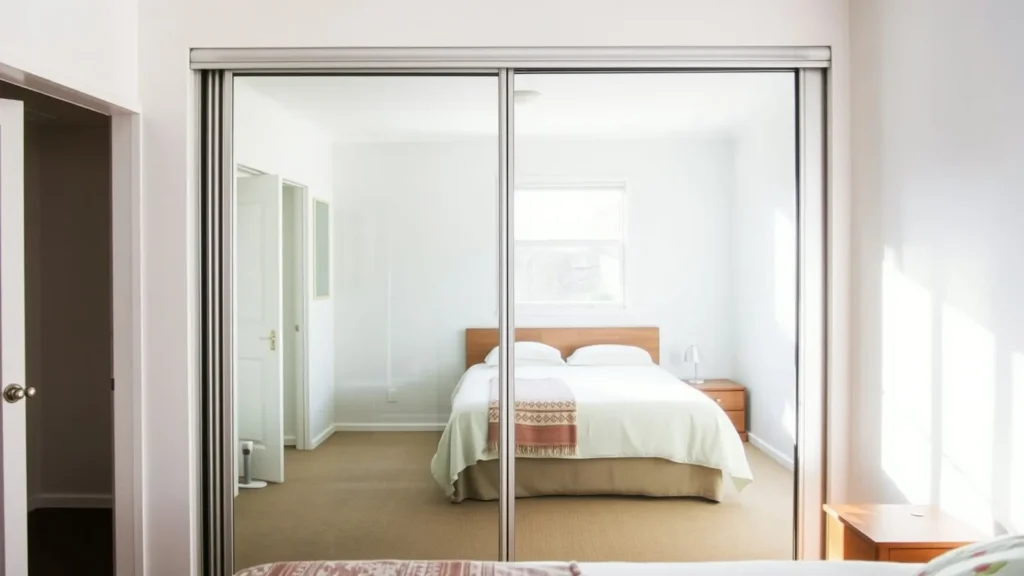
Sliding wardrobe doors are one of the hardest working fittings in a house. They open and close every day, they carry a large sheet of glass or mirror, and they sit in a bedroom where a bad noise or a stuck panel is noticed at once. When they work well you stop thinking about them. When they start to grind, jump the track or show a crack, they take over the morning.
Most guides to wardrobe doors are written for the person who is ordering a set for the first time. This one is written for the person who already has them. It covers how the doors work, what usually goes wrong, how to tell a small problem from a big one, what to check before you call anyone, and how to decide between repairing, replacing a panel and replacing the lot. If you are still at the stage of choosing a style, our earlier mirror wardrobe doors guide walks through the ordering side.
How a sliding wardrobe door actually works
It helps to understand the parts, because almost every problem comes down to one of them.
The panels. Each door is a panel of mirror or glass, either held in a metal frame or left frameless with fixings at the top and bottom. In a typical wardrobe there are two, three or four panels.
The top track. A channel fixed across the top of the opening. In many systems the panel hangs from rollers that run in this track, or is held in it for stability.
The bottom track. A channel on the floor or at the base of the opening. It guides the panel and stops it swinging into the room.
The rollers or wheels. Small wheels, at the top, bottom or both, that carry the movement. They are the parts that wear most, because they take the weight and the daily travel.
The brackets and adjusters. Fittings that attach the rollers to the panel and let the panel be raised, lowered and levelled.
The handles or finger pulls. A cut-out or a fitted pull on the edge of the panel.
The stops and bumpers. Small fittings that prevent the door sliding out of the end of the track or banging against the side.
Panels overlap, which is why a two door wardrobe only opens one half at a time. Each panel runs in its own lane of the track. If one lane is dirty, bent or worn, the panel in it complains first.
Our own range of sliding wardrobe doors includes framed doors in a choice of finishes with dual, triple or four door layouts, dual or triple track, an integrated handle, and quiet rollers with adjustable brackets. That list is a handy summary of what a modern system includes, and it is a useful checklist for what your own set should have.

Early warning signs
Doors rarely fail without warning. Most problems announce themselves weeks or months before they become a nuisance. Here is how to read the signs.
A grinding or rumbling noise. Usually dirt or debris in the track, or a worn roller that has flat-spotted. Cleaning the track often cures the first. The second needs a new roller.
A door that sticks halfway. Often a bent track, a stiff roller or a panel that has dropped slightly and is rubbing.
A door that is hard to push. The opposite of smooth. Check for weight on the panel, a dirty or dry track, or a roller that is no longer turning.
A panel that has dropped or leans. The adjuster has slipped, or a roller has worn down. You may notice a gap at the top or a panel that no longer lines up with its neighbour.
A door that jumps the track. Rollers worn or damaged, a bent track edge, or a panel that is out of level.
A rattle or a vibration. A loose bracket, a loose stop or a panel moving in its frame.
A gap that changes. If the gap between two doors grows or shrinks along the length, the panel is not hanging square.
A cracked, chipped or lifting mirror. This is a separate category and is covered below, because it brings safety questions as well as appearance ones.
A useful habit is to slide each door slowly end to end and listen. A door that moves smoothly in one direction and drags in the other is telling you where the problem sits.
What to check yourself first
A few jobs take ten minutes and often fix the complaint without a trade call.
- Empty the track. Vacuum the bottom track, then wipe it with a damp cloth. Hair, dust and grit collect in it and slow the wheels.
- Check the top track. Look along it with a torch for dirt or damage. Wipe it if you can reach.
- Look at the rollers. Open the panel gently and see whether each wheel turns freely. A wheel that is cracked, flat or jammed is a worn part.
- Check the stops and screws. Tighten any loose screws. Be gentle, because over-tightening can strip a thread.
- Look at the level. Is the panel hanging square? An adjuster may have slipped.
- Check what is leaning on the door. A loaded hanger or a bag pressed against the glass can create drag.
- Take photos. Photos of the whole wardrobe, the rollers and the track make any later quote much easier.
Do not lift a large mirror or glass panel off its track on your own unless you are sure how the system releases and you have help. These panels are heavy, the edges are sharp, and a dropped panel is dangerous. If you are not certain, stop and ask.
Rollers and tracks: the most common cause
Worn rollers are the most common reason for a noisy or stuck sliding wardrobe door. The wheel carries the weight of the whole panel every time it moves. Over years the wheel flattens, the bearing dries out or the plastic cracks.
What this looks like in daily use:
- the door feels heavier than it did,
- the noise changes from a quiet glide to a rumble,
- the panel sits lower than before,
- the door scuffs the track or the neighbouring panel,
- the door lifts off the track more easily.
What matters when you plan a fix is whether the roller can be accessed and replaced without damaging the panel, and whether parts are available for your particular system. Wardrobe door systems differ between brands and ages, and a roller from one will not necessarily fit another. Our detailed guide, sliding wardrobe door rollers, covers the checks in depth, and the next sections explain how to decide what to do.
A bent or damaged track is the other half of the story. Tracks can be knocked by a vacuum cleaner, a heavy bag or a child hanging on a door. A track that is bent even slightly makes rollers wear faster. If the track is damaged, a new roller on its own will not hold up for long.
Cracked, chipped and damaged mirror panels
A damaged panel is a different problem from a stiff door. It brings a safety question and an appearance question together.
Hairline crack. A thin crack running across the mirror. These can grow with time and temperature changes, and a panel that cracks can break further when it is slid or knocked.
Chipped edge. A chip on the edge of a mirror can spread, and the exposed edge is sharp.
Black spots, edge creep or lifting silvering. The reflective layer at the back of a mirror can deteriorate, especially near edges, where moisture sits. The mirror develops dark patches or a lifting edge. It is an ageing issue and it is not dangerous in the way a crack is, but the mirror will not recover.
A panel that has fallen or slipped. If a panel has come off the track, stop using that door until it has been checked. Glass in a damaged frame can move unexpectedly.
If a panel is cracked, treat it with care:
- Stop sliding the door if the crack could grow or the glass could shift.
- Tape across the crack, on the room side, with wide tape to hold the pieces.
- Keep children and pets away from it.
- Photograph the whole door and the damaged area, with a tape measure in the shot if you can.
- Ask a glazier what is possible.
You may need to replace the panel, which can be a good opportunity to review the whole wardrobe at the same time. Our guide, replacing a cracked wardrobe mirror, goes through how that decision works, and our glass repairs service covers damaged mirrors and glass in the home, with an emergency option when it cannot wait. Our broader guide to emergency glass replacement in Melbourne has tips for a quicker result.
A note on safety. Standard mirror glass breaks into sharp pieces. Depending on the age and type of your wardrobe, the mirror may or may not have a safety backing. Do not assume. If the mirror breaks, treat it as hazardous. Our overview of safety glass for Melbourne homes explains how glass safety is approached, and a glazier can advise on options for a replacement.
Framed or frameless: how the choice shows up later
The style of door affects how problems appear and how they are fixed.
Framed doors. The mirror sits in an aluminium frame, usually with a channel that holds it. The frame protects the edges, makes the panel stiffer and carries the rollers. Framed doors are common and come in a range of finishes. Replacing a mirror in a frame can be possible, but it depends on how the frame is constructed.
Frameless doors. The mirror itself is the door, with fittings fixed to the glass. The edges are visible, so the finish of the edge matters. Frameless doors give a clean, modern look but ask more of the glass and the fittings.
Neither is better in every home. Our guide, framed and frameless mirror sliding doors, compares the two for people who live with them, covering looks, maintenance and what happens when something is damaged.
Reading a door’s age and likely issues
Knowing roughly how old your wardrobe is helps you predict what will fail next.
Older doors with simple wheels. Often have exposed fixings and plain wheels. They tend to wear, collect dust and may be hard to source parts for.
Mid-life doors. Often have adjustable brackets and better rollers. They can last many years with a clean track and occasional adjustment.
Newer doors. Have quiet rollers and adjusters built in. They still need a clean track and a level opening.
Doors from a rental or an unknown source. Check for label marks on the frame or track. A brand or model number makes finding parts easier.
If you can read a name or number on a roller, a bracket or the frame, photograph it. It often saves time later.
Measuring and photographing for a quote
Whatever you plan to do, a glazier will ask for the same few things. Having them ready speeds up a response.
- A wide photo of the whole wardrobe, with the doors closed.
- A photo with the doors open, showing the tracks at top and bottom.
- A close photo of the damage, if any.
- A close photo of a roller or bracket, if you can see one.
- The overall opening width and height. Measure at several points, because walls and floors are rarely perfectly square.
- The height and width of each panel if you can measure it safely.
- The thickness of the mirror, if you can read it from an edge.
- A note of the finish of the frame, if it is framed.
You do not need to be exact. Rough measurements are enough to start the conversation, and a glazier can confirm on site.
Panel layouts: two, three or four doors
The number of panels changes how the wardrobe lives.
Two doors. The simplest layout. You can only reach half of the wardrobe at a time, which suits smaller openings.
Three doors. A wider opening split into three panels. You can reach more of the space, but the middle panel overlaps with both neighbours.
Four doors. Common in wide openings. More panels mean more rollers, more joins and more adjustments.
Wider wardrobes put more load on the top track, and each additional panel adds another set of rollers that can wear. If you are replacing a damaged panel in a four door set, it is worth checking all the rollers at the same time, because the other three were installed on the same day.
The role of the floor and the opening
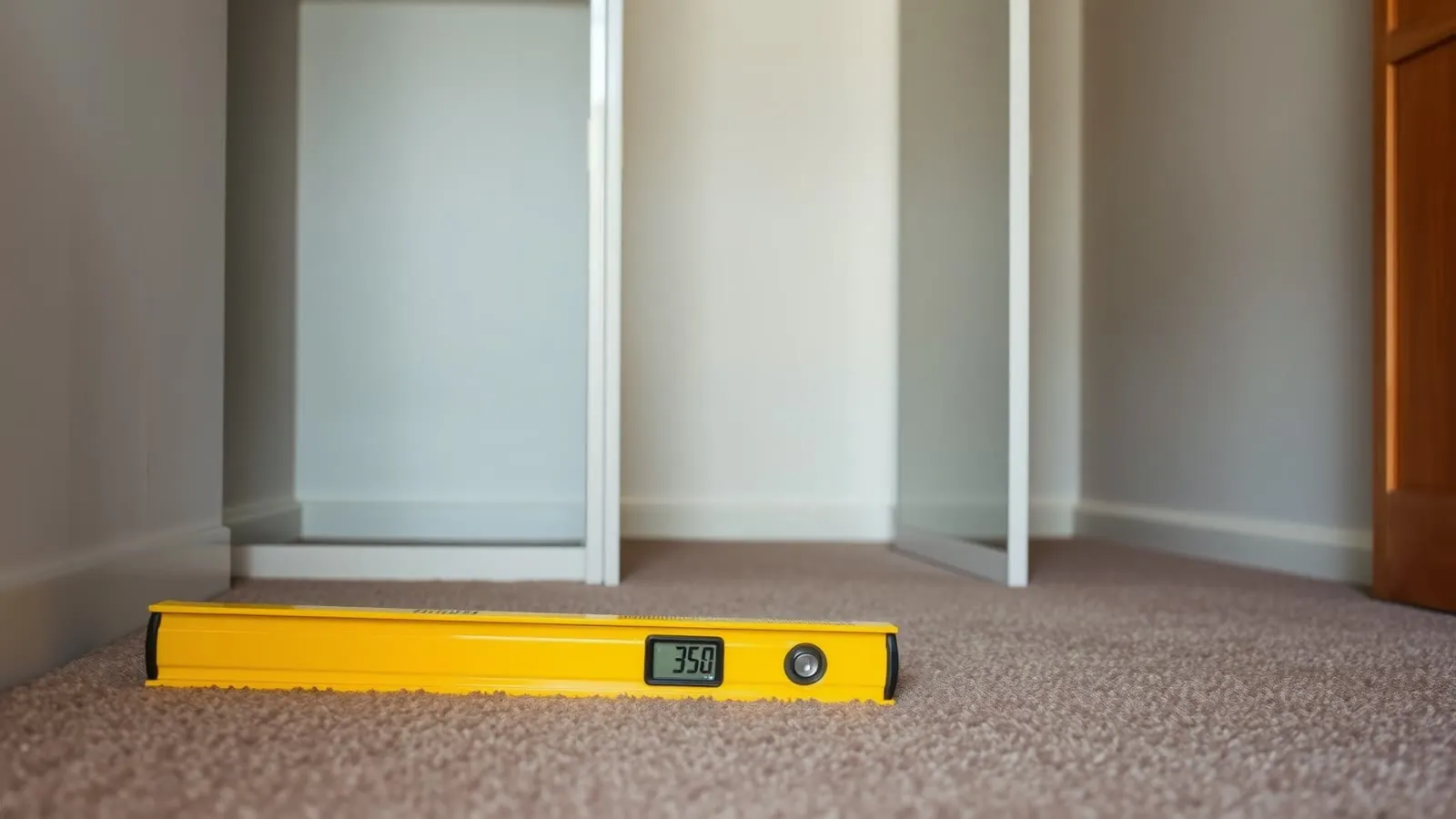
Doors can only run smoothly in an opening that is reasonably square and level.
- A sloping floor makes doors drift open or closed.
- A bowed header can pinch the top track.
- Carpet and underlay change the height at the bottom track over time.
- A wall that has moved can alter the gap at the side.
If a door has begun to behave differently without any change to the door itself, look at the opening. Seasonal movement in timber, a new floor covering or a settled wall can all change the geometry.
Mirror quality and what to look for
Not all mirrors are the same, and the differences show up in long-term use.
Flatness. A good mirror gives a true reflection. A wavy mirror stretches or bends your image. You can test this by standing back and watching a straight line, such as a door frame, in the reflection.
Edge finish. A polished or bevelled edge looks finished and is safer to handle than a raw edge. Our page on custom mirrors lists edge finishes such as flat polished, bevelled and seamed.
Backing. The back of a mirror is coated. Good coating resists damp. Poor coating spots and lifts at the edges.
Thickness. Thicker glass feels sturdier but weighs more, which puts more load on rollers and the top track.
Safety backing. Some mirrors carry a film that holds the pieces together if the glass breaks. Ask whether your mirror has one, and ask about it when you plan a replacement.
When you compare options, ask for a sample or look at a mirror installed in a home. The difference is easy to see side by side.
Cleaning and care
Mirrors are easy to look after if you follow a few steps.
- Glass cleaner on a soft cloth, not sprayed onto the edge. Spraying directly can let moisture creep behind the mirror.
- A dry microfibre cloth to finish. It prevents streaks.
- Keep the tracks clean. A monthly vacuum prevents most roller wear.
- Avoid strong chemicals. They can attack the edge sealant or the frame finish.
- Keep the room ventilated. Damp air at the edges is what makes mirrors spot.
Our guide to cleaning new glass products has more detail on what to use and what to avoid.
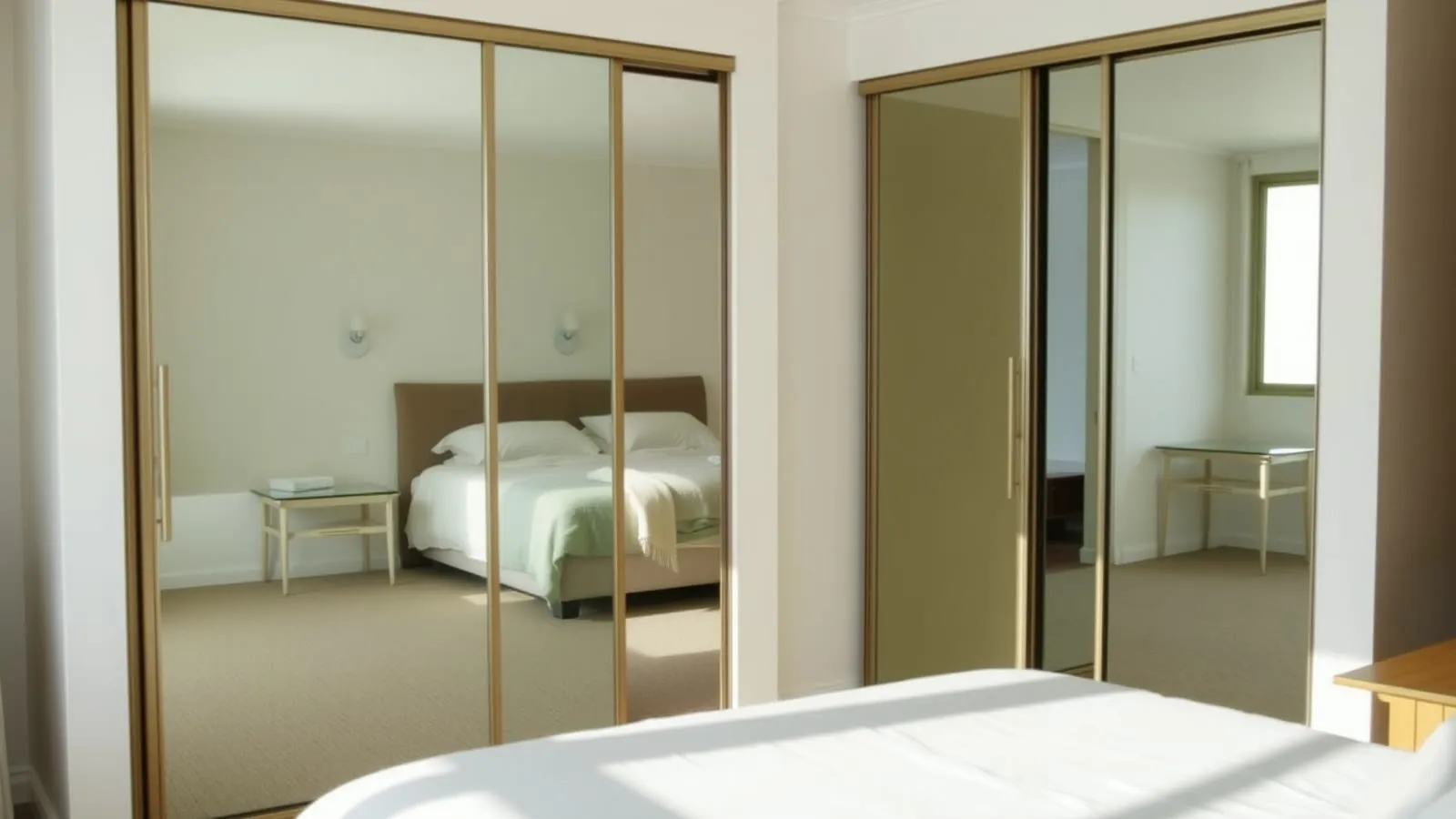
Repair, replace one panel or replace the whole wardrobe
This is the central question for most households, and it is worth thinking about calmly rather than in the middle of a bad morning.
Repair the system when:
- the doors are in good condition and only a roller, stop or bracket has failed,
- the track is straight and clean,
- the doors are a style you still like,
- spare parts are available for your system.
Replace one panel when:
- a single mirror is cracked, chipped or badly marked,
- the rest of the panels and the frame are sound,
- a matching panel can be made to size,
- the wardrobe is otherwise working well.
Replace the whole set when:
- the track is badly damaged or no longer straight,
- parts cannot be found and the doors are failing across the board,
- the frames are worn, bent or corroded,
- you want a different look, finish or layout,
- you are renovating the room anyway.
There is no single right answer. A sound set with one cracked mirror suits a panel replacement. A tired set with noisy doors across the board often suits a full change.
Doors and the rest of the room
A wardrobe sits in a room that does other jobs.
Light. Mirror doors bounce light around a room. A wardrobe opposite a window can brighten a bedroom noticeably. Placed badly, they can create glare.
Space. A large mirror makes a room feel wider. It also shows clutter, so a tidy interior matters.
Privacy and morning habits. A full length mirror is practical, and it changes how a room feels. Think about what it reflects from the bed or the door.
Noise. Poorly adjusted doors can be noisy at night. Quiet, well adjusted rollers matter in a bedroom.
If you are choosing a new set, our guide to mirror door options explains options for hanging and fixing mirrors on doors, and our guide to mirror sizing and cut to size options explains how sizes are measured and finished.
Questions to ask any supplier
If you are getting quotes, whether for a roller, a panel or a whole set, these questions keep the comparison fair.
- What exactly will you do, and what is included? Removal, delivery, installation and tidying up.
- Is the replacement made to size or taken from stock?
- Will it match the existing panels? Ask about frame finish, mirror tint and thickness.
- What happens to the old panel? Disposal is part of the job.
- Can the existing track be reused? If it is damaged, say so now.
- What are the timeframes? Ask when you can expect the work.
- Is there a warranty, and what does it cover?
- Who do I call if something is wrong afterwards?
Keep the answers side by side. A fair comparison starts with an agreed scope.
What Economy Glass can do
Economy Glass is a glazier in Hoppers Crossing, serving Melbourne’s west. Here is how that relates to wardrobe doors.
- We make mirrors to measure, including frameless vanity mirrors and wardrobe doors, with a choice of edge finishes, and a home assessment with measuring.
- We offer framed and frameless sliding wardrobe doors in a range of finishes, with dual, triple and four door layouts.
- We repair mirrors, windows, doors, shower screens and shopfronts through our repair service, with an emergency option.
If your wardrobe issue is something outside that list, such as a particular brand of roller or a mirror that must fit a particular frame, send us the details and photos. We will tell you plainly whether it is something we can help with, and we would rather say so up front than leave you waiting.
For a look at how glass choices run through the rest of the bedroom and bathroom, our guide to frosted, obscure and privacy glass covers the options for windows and doors where light matters more than a reflection.
A planning checklist
- Note the symptoms: noise, sticking, dropping, jumping or cracking.
- Clean both tracks and look at the rollers.
- Photograph the wardrobe, the tracks and any damage.
- Measure the opening and, if safe, each panel.
- Decide whether you want to keep the style or change it.
- Ask for a clear description of every item in a quote.
- Check lead times for made-to-size panels.
- Keep the old fittings until the job is done, in case you need to compare.
Frequently asked questions
Why is my sliding wardrobe door so noisy?
Most often because of dirt in the track or a worn roller. Clean both tracks first. If the noise remains, a roller may need replacing.
Why does my wardrobe door keep coming off the track?
Usually worn rollers, a bent track edge or a panel that has dropped out of level. Stop using the door and have it checked, because a panel that comes off can fall.
Can I replace just the mirror in a sliding wardrobe door?
Sometimes. It depends on the frame and how the mirror is held. Send photos and measurements and a glazier can tell you what is possible.
How do I know if my wardrobe door needs new rollers?
Signs include a rumbling noise, a door that is harder to push, a panel that sits lower than before and a door that scuffs the track. Check whether the wheels turn freely.
Is a cracked wardrobe mirror dangerous?
It can be. A cracked mirror can break further and the edges are sharp. Tape across it, keep the door still and ask a glazier to look at it.
Are framed or frameless doors better?
It depends on your taste and the room. Framed doors protect the edges and are common. Frameless doors give a cleaner look. Our guide to framed and frameless mirror sliding doors compares them.
Can I adjust the height of a wardrobe door myself?
Many systems have adjusters on the brackets. Be careful, because the panels are heavy. If you are not sure how yours works, ask for help rather than lifting a panel yourself.
How often should I clean the track?
A light vacuum once a month is enough for most households, and it prevents most roller wear.
Do wardrobe mirrors have safety backing?
Some do and some do not. Do not assume. Ask when you plan a replacement.
How do I get a quote for wardrobe door work?
Send photos of the wardrobe, the tracks and any damage, plus rough measurements of the opening. That is enough to begin.
A calm next step
If your wardrobe doors are noisy, stuck or damaged, or you are thinking about a new set, you are welcome to send photos and rough measurements on our request a quote page. We will tell you plainly what we can do, with no pressure.