



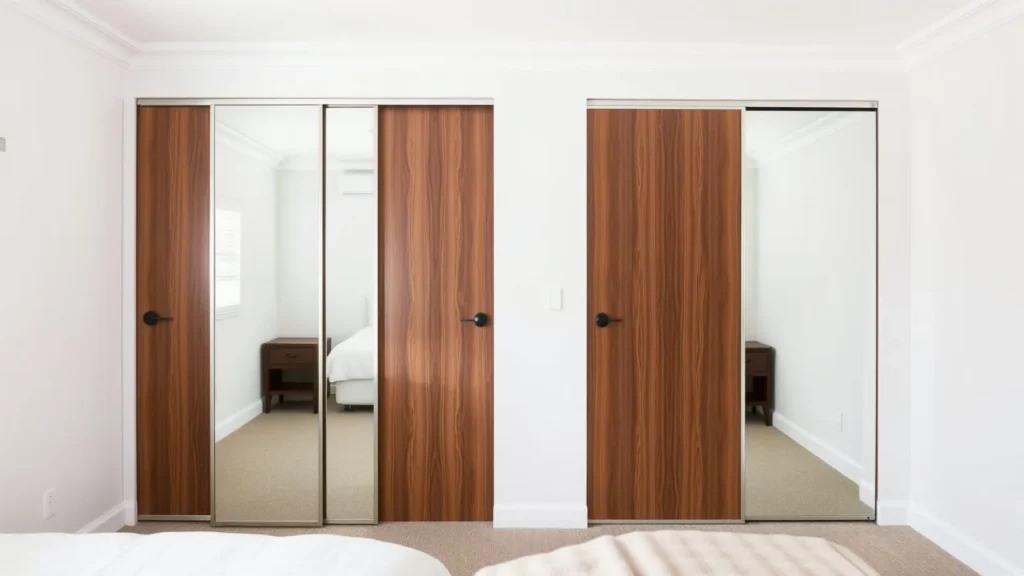
Mirror sliding doors do two jobs at once. They close off a wardrobe, and they give a bedroom a full length mirror and a lot more apparent light. The choice that matters most is how the mirror is held: in a frame, or with no frame at all.
This guide sits under our main guide to sliding wardrobe doors. It focuses on one question: which style suits the way you live? It does not repeat the full ordering process, which is covered elsewhere. Instead it looks at how each style looks, feels and behaves day to day, so you can decide before you start measuring.
The basic difference
Framed mirror sliding doors. The mirror sits inside a surround, usually aluminium, that holds all four edges. The frame also carries the rollers and gives the door its stiffness.
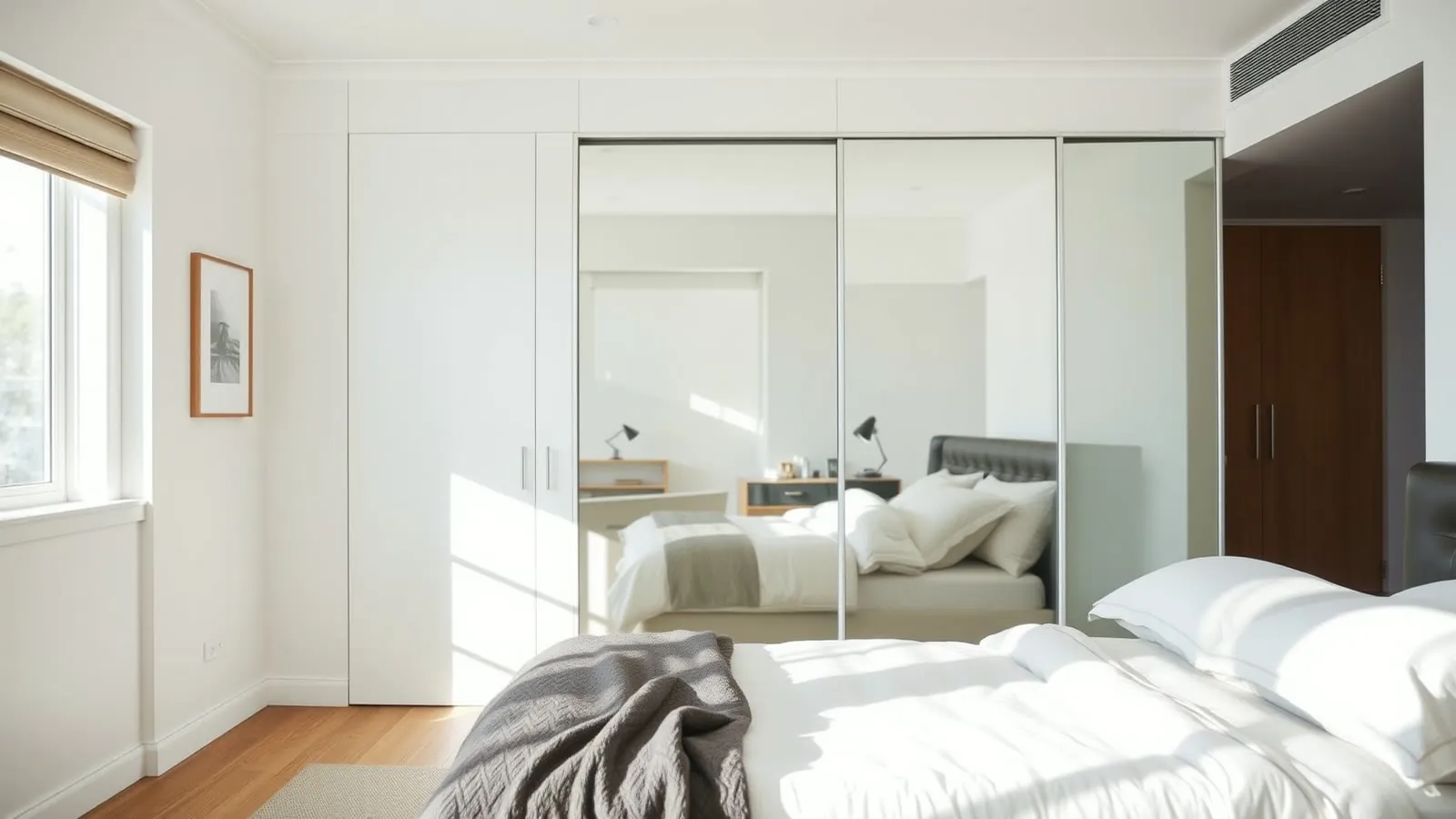
Frameless mirror sliding doors. The mirror itself is the door face. There is no surround around the glass edge, so you see the mirror right to its edge. Hardware, such as a handle or a top and bottom channel, is kept discreet.
Neither is better in every case. They suit different rooms, different habits and different budgets of attention.
How they look
Framed doors give a defined edge. The frame draws a line around the mirror, which suits traditional and contemporary rooms and works well when you want the doors to read as furniture. Frames come in a choice of finishes, which helps tie the doors in with other fittings.
Frameless doors give a clean, continuous mirror. With no frame to interrupt it, the reflection looks wider and the doors can seem to disappear into the wall. This suits minimal rooms, and small bedrooms where you want the mirror to open the space up.
A useful trick is to stand in the room and picture the doors closed. Do you want to see a mirror, or do you want to see a door with a mirror in it?
How they feel in daily use
You use the doors every day, so the feel matters as much as the look.
- Handles. Framed doors often have an integrated handle in the frame. Frameless doors tend to have a lower profile grip, so you may be pulling at the glass edge or a small fitting.
- Movement. A frame gives a door some rigidity, which can make it feel more solid when it slides.
- Weight. A large mirror panel is heavy either way. A frame adds a little weight.
- Sound. Door noise depends on the rollers and the track more than on the style, so check how the doors run in person if you can.
Our framed and frameless sliding wardrobe doors page lists what is available: framed doors in a range of colours with dual, triple and four door layouts, dual or triple track, an integrated handle and quiet rollers with adjustable brackets, and frameless doors in a smaller range of colours.
Cleaning and upkeep
Framed doors.
- The frame gives you something to hold when cleaning.
- Dust can collect where the glass meets the frame, so run a soft cloth or brush along the join.
- Frame finishes need gentle cleaning to avoid scratches.
Frameless doors.
- A smooth face is quick to wipe from edge to edge.
- Edges are exposed, so avoid knocking them with vacuum cleaners and furniture.
- Moisture at the edge can be a concern in a damp room, so ventilate where you can.
Either way, use a soft cloth and a mild glass cleaner, spray the cloth rather than the mirror so liquid does not run into the edges, and avoid abrasive pads.
Strength and protection
Frames protect the edges of the mirror. If your doors take a lot of knocks, such as in a child’s room, a framed door adds a margin of protection.
Frameless doors expose the edge. A well finished polished edge looks neat, but a chip at an exposed edge is more likely to be seen and can sometimes spread. If you choose frameless, treat the doors with a little more care.
If you are concerned about safety if the glass breaks, ask what backing or glass type is used on the mirror, and compare the answers between suppliers.
Size, openings and layout
How the doors fit into your opening matters more than most people expect.
- Width. Doors overlap when they slide, so a two door wardrobe only opens about half the width at a time. Three doors give a different access pattern.
- Height. Tall rooms may suit a single full height panel. Ceilings that are not level need the doors to be fitted with some allowance.
- Floor and ceiling. Slopes in either one affect how well the doors fit and slide. Measuring at several points shows the real picture.
- Door count. More doors mean narrower panels, which can feel lighter in use but show more joins.
Our guide to a mirror on a door is a useful look at how mirrors behave when fixed to a door surface, which is helpful background if you are weighing up the two ways of holding a mirror.
Mirror quality and the reflection
Whichever style you choose, the mirror itself deserves a look.
- Clarity. Check a sample for waviness in the reflection.
- Edges. Ask how the edges are finished.
- Backing. Look at the back and the edges for signs of spotting or lifting.
- Colour. Some mirrors are very clear and some have a slight tone.
If you want a mirror made to a particular size, see our page on custom mirrors, which covers edge finishes such as flat polished, bevelled and seamed, and mentions a home assessment with measuring.
A quick way to decide
Choose framed if:
- you want a defined, furniture-like look,
- you want a built in handle,
- the doors will take knocks,
- you like a choice of finishes,
- the room is traditional or mixed in style.
Choose frameless if:
- you want the cleanest, widest reflection,
- the room is small and you want it to feel open,
- you prefer a minimal look,
- you are happy to take a little more care of the edges.
If you are still unsure, imagine the wardrobe in five years. Which one would you still like?
Existing doors and replacement
If you already have mirror sliding doors and one of them has a problem, you may not need a full change. Rough or noisy doors often come down to the track and wheels, which we cover in sliding wardrobe door rollers. If you are choosing replacements anyway, the style decision above applies in the same way.
Our wider guide to mirror wardrobe doors explains the ordering steps in detail, so we have left them out here.
What Economy Glass can help with
Economy Glass supplies sliding wardrobe doors, framed and frameless, and cut to size mirrors. We are based in Hoppers Crossing and have worked with glass for over 45 years. If you are choosing between the two styles, send a photo of your wardrobe and the opening, and we will tell you plainly what we would suggest.
Frequently asked questions
What is the difference between framed and frameless mirror sliding doors?
Framed doors hold the mirror in a surround. Frameless doors show the mirror to its edge with no surround.
Which is easier to clean?
Frameless doors have a smooth face that wipes quickly. Framed doors are easy too but need a little care along the frame join.
Are frameless mirror doors less safe?
Not necessarily, but the edges are exposed so they need more care. Ask about backing and glass type with either style.
Do frameless doors make a room look bigger?
Often yes. With no frame to break it up, the reflection looks wider.
Can I choose a colour?
Framed doors come in a range of colours. Frameless doors come in a smaller range.
How many doors do I need?
That depends on the opening. Dual, triple and four door layouts are available, and the right one depends on width and how you want to access the wardrobe.
Can I send photos for advice?
Yes. Photos of the wardrobe and the opening help a lot.
A calm next step
If you are choosing between framed and frameless mirror sliding doors, send us photos and rough measurements on our request a quote page. We will tell you plainly what we would suggest, with no pressure.