




Double glazing cost makes more sense once you know exactly what is being replaced. Changing an existing double glazed unit, investigating an upgrade from single glass and replacing an entire window are different jobs. A useful quote starts with that distinction, before anyone compares totals.
For a Melbourne home with existing windows, the first question is what the frames can accept. The next is what glass specification suits the opening and the problem you want to solve. The focus here is replacement glass, not a whole-window supply or a new-build package.
The aim is to help you prepare a clear brief, recognise missing information and compare proposals that describe the same work. There is no reliable shortcut from a photograph of a window to a complete replacement specification.
Double glazing cost starts with the scope
Write down the job in a sentence before requesting a quote. For example: replace the failed double glazed unit in the fixed bedroom window, retaining the existing frame subject to inspection. That tells the glazier much more than a request for double glazing throughout the house.
A second example might be: assess whether the existing single glazed living-room windows can accept sealed double glazed units. Here, suitability has not been established. The assessment needs to happen before a replacement proposal can be treated as an agreed solution.
A third household may have damaged glass and a sash that no longer closes. That requires two separate observations. Replacing glass addresses the pane, but the proposal also needs to explain how the operating problem will be handled. Do not assume an allowance for one includes the other.
Keep these categories separate when reading advertisements or collecting estimates. A low-looking total for glass alone cannot be meaningfully compared with a proposal covering removal, installation and additional work around the opening. Ask each provider to identify its boundary in writing.
For the room-by-room replacement process, see Double glazing Melbourne: replacing existing glass. If your windows currently have single glass, the feasibility questions are covered in Double glazing retrofit: what is possible.
Replace a unit or change a glazing system
An existing double glazed window already has a space designed for a particular glazing assembly. A replacement still needs checking, but the starting point differs from a single glazed frame being considered for an upgrade.
Do not describe both requests merely as adding another pane. That phrase leaves too much unspecified. Tell the glazier what is there now, what is damaged and what you hope to retain. If you cannot identify the existing arrangement, send photographs rather than selecting a technical description at random.
What belongs in a replacement quote
A quote should let you recognise the windows it covers. Room names help, but a room with several panels also needs a location or label. A sketch marked left fixed panel, centre opening sash and right fixed panel is easier to check than an unlabelled list of glass sizes.
Ask for the proposed glass description, the number of units and the installation scope. Find out how the final specification will be confirmed and which parts of the proposal remain provisional. A clear document can contain qualifications. The useful qualification explains what still needs inspection and what could change as a result.
Economy Glass’s quotation information asks about frame material, approximate measurements, room location and whether a panel opens. It also states that telephone quotes are subject to a final site survey. Those details provide a practical starting point for a replacement enquiry.
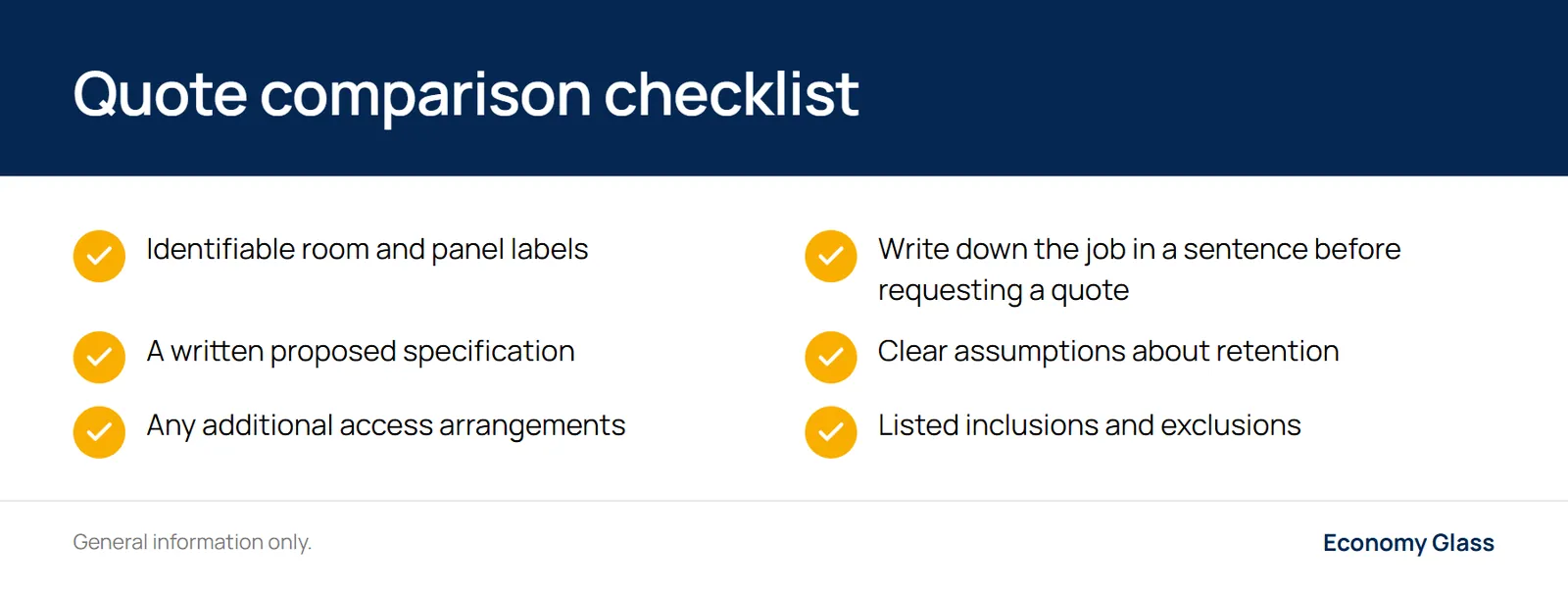
| Quote item | What to look for | What to clarify |
|---|---|---|
| Openings | Identifiable room and panel labels | Any windows omitted |
| Glass | A written proposed specification | How the final selection is confirmed |
| Existing frame | Clear assumptions about retention | Conditions that would prevent replacement |
| Installation | Defined removal and fitting work | Any additional access arrangements |
| Associated work | Listed inclusions and exclusions | Responsibility for work outside glazing |
The table is a reading aid, not a promise about a particular supplier’s inclusions. Ask for the actual terms of your proposal rather than assuming that a familiar heading covers everything underneath it.
Size, shape and the number of separate units
Do not reduce a replacement enquiry to the overall width of the wall of glass. Identify each separate panel. A broad opening can contain fixed glass, an opening section and another fixed section, each needing its own assessment.
For initial planning, note approximate visible dimensions only where you can do so without approaching damaged glass or climbing. Mark them as approximate. Do not remove glazing beads or expose an edge to improve the measurement. The fitting dimensions are for the glazier to establish.
Shape matters to the description as well. A rectangle, an angled pane and glass with an unusual outline should not be grouped under the same assumption. Photograph the whole opening so the person reviewing the enquiry can see what the measurements refer to.
The number of separate units also belongs in your comparison. Imagine one proposal covers the large fixed pane and another includes the adjoining opening panes. Their totals describe different scopes, even if both are labelled living-room double glazing. Resolve that difference before asking either provider to revise its figure.
Use a window schedule that you can check
A schedule need not be elaborate. Give each opening a label, then record the room, current concern, frame material if known and opening style. Attach photographs using those same labels. Keep uncertain details marked unknown.
This prevents a common planning problem: a household agrees to the main living area, then later realises that a small side panel was never included. The best schedule is the one you can walk around the house and verify without interpreting technical drawings.
Glass specification should follow the job
Avoid choosing a glass description solely because it sounds like the most advanced option. Start with the concern at the particular window. A cracked unit, an unclear view, discomfort beside a window and intrusive noise are different reasons for seeking advice.
Tell the glazier what happens in that room. Describe when the discomfort occurs, where you notice it and how the window is used. Ask which features of the proposed specification address that concern. The answer should connect the recommendation to your opening, rather than rely on a broad claim about double glazing.
If different options are proposed, ask for their differences to be written down. Keep the installation scope unchanged while comparing them. Otherwise you may think you are comparing glass choices when one proposal also changes the number of openings or excludes fitting work.
The wider question of choosing efficient glazing belongs in Energy efficient windows: what makes a window efficient. Here, the useful decision is narrower: establish which specification is actually included in the replacement quote and why it was selected.
Avoid an unspecified upgrade
The phrase upgraded glass is incomplete. Ask what changes from the existing arrangement, what remains the same and what performance information supports the recommendation. If a provider cannot identify the proposed product clearly, there is little basis for comparing it with another option.
Do not write your own specification from a generic online example. Provide the problem and the existing conditions, then ask for a suitable recommendation. That leaves the technical selection with the person assessing the opening while keeping you in control of the brief.

Read the specification behind the total
Double glazing is not a single glass specification. The Australian Government’s Your Home glazing guide explains that insulated units combine glass layers with a sealed cavity. Their performance depends on the glass, cavity and sealing. The guide also distinguishes heat conduction, measured by U value, from solar heat gain, measured by SHGC.
For a quote comparison, ask which of those details differs between the offered options. Request the glass description and any relevant performance information together. A proposal for clear glass and a proposal involving a coating should not be treated as interchangeable merely because each uses the words double glazed.
Keep that discussion tied to the quoted opening. Ask whether any supplied performance figure describes the glass alone or the complete window. Your Home explains that frames also affect thermal performance. A figure for a different frame and glass combination should not be read as the measured result for your retained window.
You can organise the comparison without choosing the technical answer yourself. Put the recommended option beside the alternative, then ask the glazier to explain the reason for the difference. Include fit and installation conditions in that explanation. A technically attractive option still needs to be suitable for the actual opening.
Ask for changes to be priced as changes
Consider a hypothetical quote covering the fixed glass in a living room and study. After reading it, the owner asks to include an adjoining opening section and explore a different specification for the study. Those requests should be visible as changes to the original brief.
Ask for a revised document that identifies the added opening and the altered specification. Keep the previous version for reference, but make sure the accepted version is unmistakable. Do not combine a new total from one message with inclusions taken from an older quote.
If you decide against the additional work, ask for the final proposal to return to the intended scope explicitly. This is particularly useful when several alternatives have been discussed. The installer and homeowner should be working from the same accepted description, rather than reconstructing the decision from separate conversations.
Keep essential and optional work visible
Ask which items are necessary to complete the proposed replacement and which are optional changes requested by you. For example, your enquiry might begin with a damaged bedroom unit, then expand to include an assessment of unaffected study glass. Keep those requests separate in the paperwork.
This gives you a practical way to adjust the project without asking for unspecified shortcuts. You can defer a discretionary opening while retaining the assessed scope for the damaged one. If a proposed change affects the suitability of the remaining work, ask for that consequence to be explained before deciding.
Existing frames can decide feasibility
Frame suitability is a decision point, not a minor detail to leave until fitting. Economy Glass’s existing double-glazing article warns that many aluminium window profiles cannot be retrofitted with double glazing. That makes an unconditional promise about retaining every frame inappropriate.
Ask for each window type to be assessed on its own merits. Two openings in the same house may look alike from inside but have different arrangements. A fixed pane and a moving sash should not automatically receive the same feasibility answer.
Describe visible deterioration, sticking and water staining when making the enquiry. These observations do not diagnose the cause. They tell the assessor where to look and help prevent an estimate based on an assumed sound opening from being mistaken for a confirmed installation plan.
If retaining the frame is not suitable, ask for that conclusion to be stated clearly. It is better to understand the boundary of a replacement-glass job than to approve a proposal built around a frame that cannot support the intended solution.
Separate confirmed work from conditional work
A useful proposal distinguishes what has been inspected from what has only been assumed. For instance, a quote based on photographs may still require confirmation of the existing glazing arrangement. That condition should remain visible when you compare it with a measured proposal.
Ask what finding would change the plan. Would the glass specification need revising? Would associated work be necessary? Would the replacement-only approach stop being suitable? The aim is to understand the decision before work proceeds, without asking anyone to guarantee unseen conditions.
Access and the work around the window
Give the glazier an honest picture of the work area. Include a wide photograph as well as a close view of the window. A close-up can show the pane clearly while hiding a narrow passage, fixed cabinetry or a difficult approach to the opening.
List what can be moved and what cannot. A lightweight chair is different from a built-in bench. Do not assume that an installer will move furniture, remove blinds or arrange access equipment unless the proposal says so.
For an upper-level window, describe its position from the ground rather than attempting an external measurement. Ask how access will be assessed and whether the quoted scope already addresses it. Keep this as a practical site question, not a reason to improvise a way to reach the glass yourself.
Access can also involve people. In a shared building, find out who manages entry to common areas and what arrangements need checking. Do not promise access through a neighbour’s property or a common courtyard before the relevant person has agreed.
Put responsibilities beside the work
A note saying access required is less useful than a description of who arranges it. Ask the same question about moving obstructions, protecting nearby surfaces and reinstating anything disturbed.
Where an item belongs to another trade or building manager, keep it separate in your planning notes. That way, an apparently complete glass quote does not become your only record of a job that also depends on unrelated work.
Comparing like with like
Begin with the scope, then compare the proposed solution. Put the quotes beside your window schedule and check that each covers the same labels. Resolve missing panels before moving on to technical differences.
Next, compare the written glass descriptions. If they differ, ask each provider to explain the practical reason for its recommendation. You are not obliged to choose identical products, but you should know when different totals correspond to different solutions.
Then read the installation details and conditions. Check how removal, fitting, associated work and access are described. Note any item that is excluded, provisional or dependent on further inspection. An empty space in a quote is a question to ask, not an inclusion to assume.
Finally, ask how changes will be handled. A clear variation process explains how a newly identified issue is discussed and agreed. It should let you understand the next decision before extra work is authorised.
A hypothetical comparison
Suppose one household requests replacement glass for a bedroom and a study. The bedroom has an existing double glazed unit with a damaged pane. The study has single glass, and the owner hopes to upgrade it while retaining the frame.
One proposal assesses the bedroom only. Another allows for assessment of both rooms but has not confirmed the study’s suitability. Those documents should not be ranked as if they cover the same completed work. The missing step is a clear feasibility answer for the study, followed by an aligned scope.
Once the scope is aligned, the household can consider the merits of each proposal. Until then, selecting the smaller total would simply mean choosing a different job without acknowledging it.
Plan stages around a clear reason
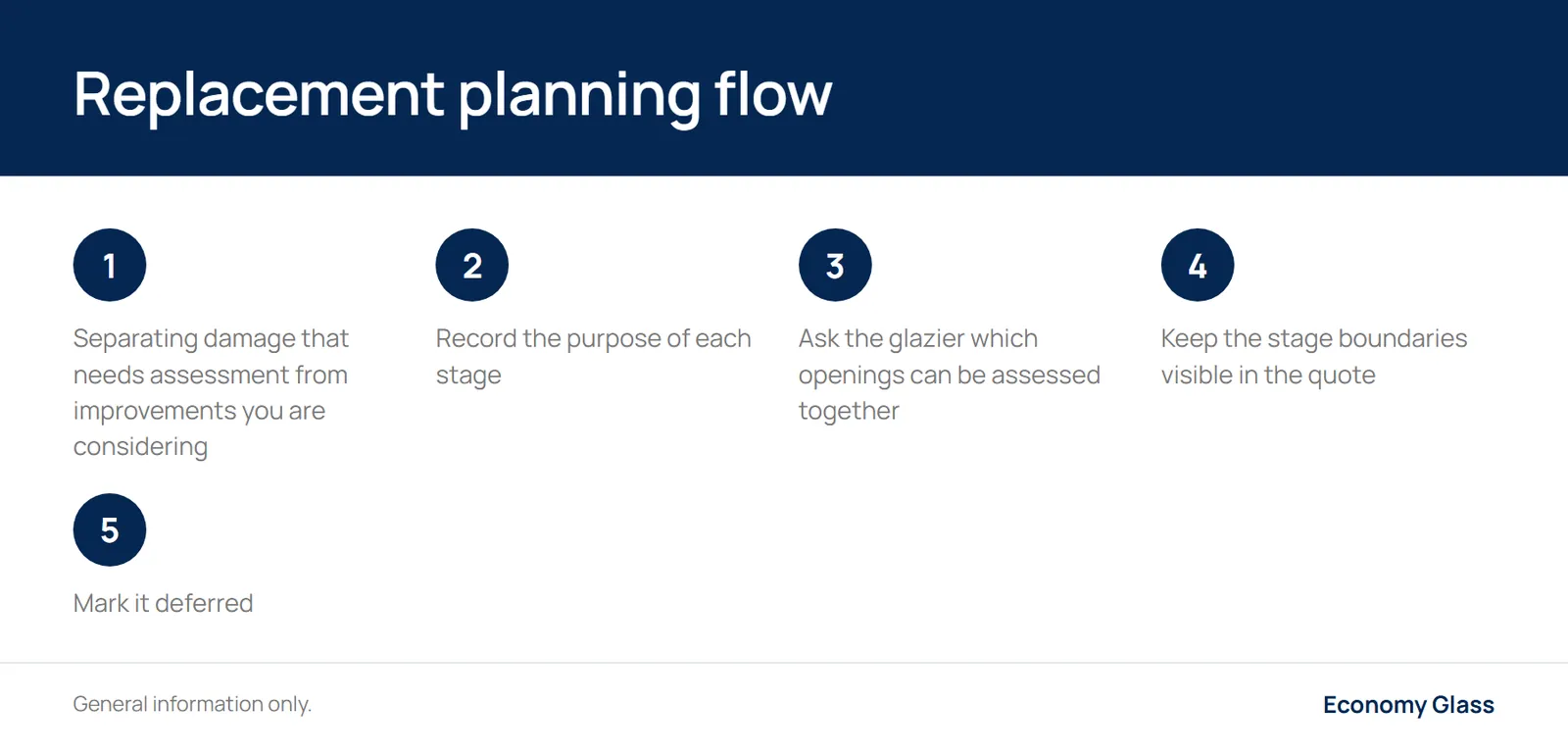
You do not need to treat every window as one undifferentiated project. Start by separating damage that needs assessment from improvements you are considering. An unsafe opening should not be left unresolved while you decide on the appearance of another room.
For planned upgrades, record the purpose of each stage. A bedroom may be your first assessment priority because sleep is being interrupted. A living area may follow because it is uncomfortable at a particular time of day. These are homeowner priorities, not promised performance results.
Ask the glazier which openings can be assessed together and which decisions depend on the same information. Keep the stage boundaries visible in the quote. If you defer a room, mark it deferred rather than letting it disappear from the schedule.
Staging also needs realistic communication. Do not assume that a later stage will have the same specification, terms or timing as an earlier one. Ask for the later work to be confirmed when you are ready to proceed.
What to send with the first enquiry
Prepare a short description of the problem and a labelled photograph of each opening. Include the room, approximate size where safe, frame material if known and how the window opens. Economy Glass’s quotation guidance supports gathering these details before a final site assessment.
Describe symptoms rather than deciding their cause. Write that the view looks cloudy between panes if that is what you observe. Write that water appears on the room-facing surface if that is where you can safely see it. Leave a technical diagnosis to the inspection.
Before sharing a full street address, you can use Economy Glass’s coverage information to check the relevant service enquiry route.
Keep the request focused. A useful enquiry asks for replacement-glass assessment of named openings, explains the concerns and asks what further information is needed. A long list of product names copied from unrelated websites can make the intended job less clear.
Photograph for context
Take a whole-window image, a room-context image and a closer image from a safe position if it helps show the concern. Photograph handles or an existing label only if you can do so without moving damaged glass.
Avoid opening a cracked sash merely to demonstrate its movement. Describe how it normally opens instead. For sound windows, a written note about the opening style can be enough for the first conversation. The purpose of the photographs is to support assessment, not replace it.
Questions worth asking before accepting
Ask what the proposed work replaces and what remains. Request a clear answer about the glass unit, frame, opening sash and any associated work. This prevents a broad word such as replacement from carrying several different meanings.
Ask which parts of the proposal have been confirmed by inspection. If something remains provisional, ask when it will be resolved. A useful answer identifies the check and its place in the process.
Ask why the proposed glass suits the opening and the concern you described. Keep comfort, noise and appearance questions distinct so that an answer about one is not mistaken for a guarantee about all of them.
Ask what the quote excludes. Then ask who is responsible for those items if they are needed. An exclusion is manageable when you understand it before approving the job.
Ask what you need to prepare before attendance and what happens after fitting. Get the actual instructions for the proposed work rather than using a generic checklist as if it were the installer’s procedure.
Finally, ask how any change to the agreed scope is communicated. You should be able to recognise the original work, the newly identified issue and the decision being requested. Keep the written answer with your quote and window schedule.
Details that are easy to overlook
Check the description of appearance as well as function. If you are replacing only one unit in a group, tell the glazier that the adjoining glass will remain. Ask what information is needed to discuss the visual result. Do not assume that a generic glass description answers every appearance question.
Record privacy needs for bathrooms or rooms facing neighbours. These belong in the initial brief, even if your main concern is a damaged pane. Leaving them until after a specification is agreed can mean the proposal needs to be reconsidered.
Mention any existing films, decorative details or fittings visible at the opening. Ask how they affect the assessment and what the proposal includes. Do not assume an applied feature transfers to replacement glass or that removing it is part of the quoted work.
Keep photographs of the surrounding condition before the job. This gives everyone a shared reference for existing marks or deterioration and the intended work area. Use the record to support a clear handover, without treating it as a substitute for the installer’s own assessment.
Review the finished scope at handover
Use the same window labels after installation that you used for the enquiry. Check that the agreed openings correspond to the completed work. Ask the installer to explain anything that differs from the proposal while the job is still fresh in everyone’s mind.
For opening windows, ask about the appropriate operation check and follow the installer’s guidance. Do not force an unfamiliar handle or adjust hardware yourself to make the result match an assumption. Raise any concern with the person responsible for the work.
Request the relevant care information and retain the written glass description with your household records. Ask any questions about supplied terms directly.
A clear record also helps a future enquiry. Instead of starting again with an unidentified pane, you can provide the room label, the replacement description and the paperwork for the work that was actually completed.
Frequently asked questions
Can I compare double glazing by window area alone?
Area is only part of the description. Compare the same openings, proposed glass, frame assumptions, access and installation scope. An area-based comparison can hide differences in what each proposal actually includes.
Does replacement glass mean a new frame?
Not necessarily. Ask the quote to state what is retained and what is replaced. Frame suitability should be assessed before the proposed work is confirmed.
Can existing single glazed windows always be upgraded?
No. Economy Glass’s double-glazing article warns about unsuitable aluminium profiles. Ask for an assessment of the actual frame rather than relying on its appearance or material alone.
Should I supply exact measurements?
Provide approximate information only where you can obtain it safely, and label it accordingly. Economy Glass’s quotation guidance says telephone quotes remain subject to a final site survey. Do not dismantle glazing to measure it.
Can a quote promise lower household bills?
Treat a proposed glass specification separately from a prediction about your household spending. Ask what evidence supports any claimed result and what assumptions it uses.
What if I want to replace only one failed unit?
Describe that opening specifically and identify the adjoining glass that will remain. Ask for a replacement assessment of that unit, rather than requesting an unspecified whole-house upgrade.
If you have a window schedule or photographs ready, ask Economy Glass for a replacement-glass quote. You can start with the openings causing concern and confirm the suitable scope after assessment.