



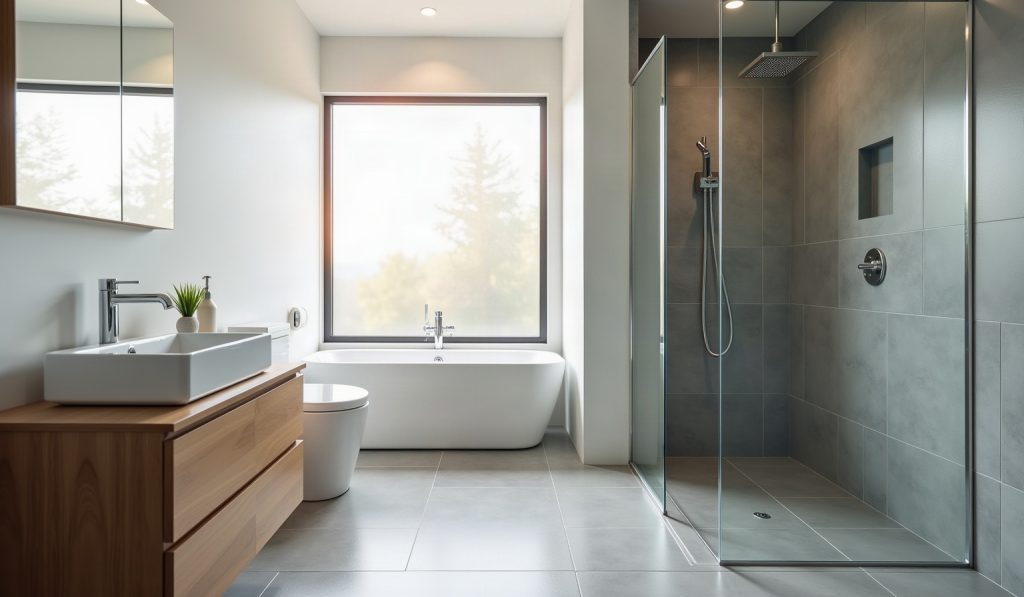
Shower screens are the last big decision in a Melbourne bathroom renovation and the one that carries the most rules. The glass has to be Grade A safety glass under AS 1288. The waterproofing underneath it has to meet AS 3740. And the screen cannot be measured until the tiles are on the wall, which means the people who fix the floor, the membrane and the tiling set the conditions for the glass before the glazier ever walks in. Get the order wrong and you pay for it in leaks, mould and a screen that does not quite fit.
This guide is for anyone renovating a bathroom in Melbourne’s west in 2026. It covers where the screen sits in the sequence, what the waterproofing standard means for your layout, what hobless showers change, how to choose glass and hardware, what soft water does to glass, what a leak does to a bathroom, and when to repair or replace an old screen.
The Melbourne bathroom renovation market in 2026
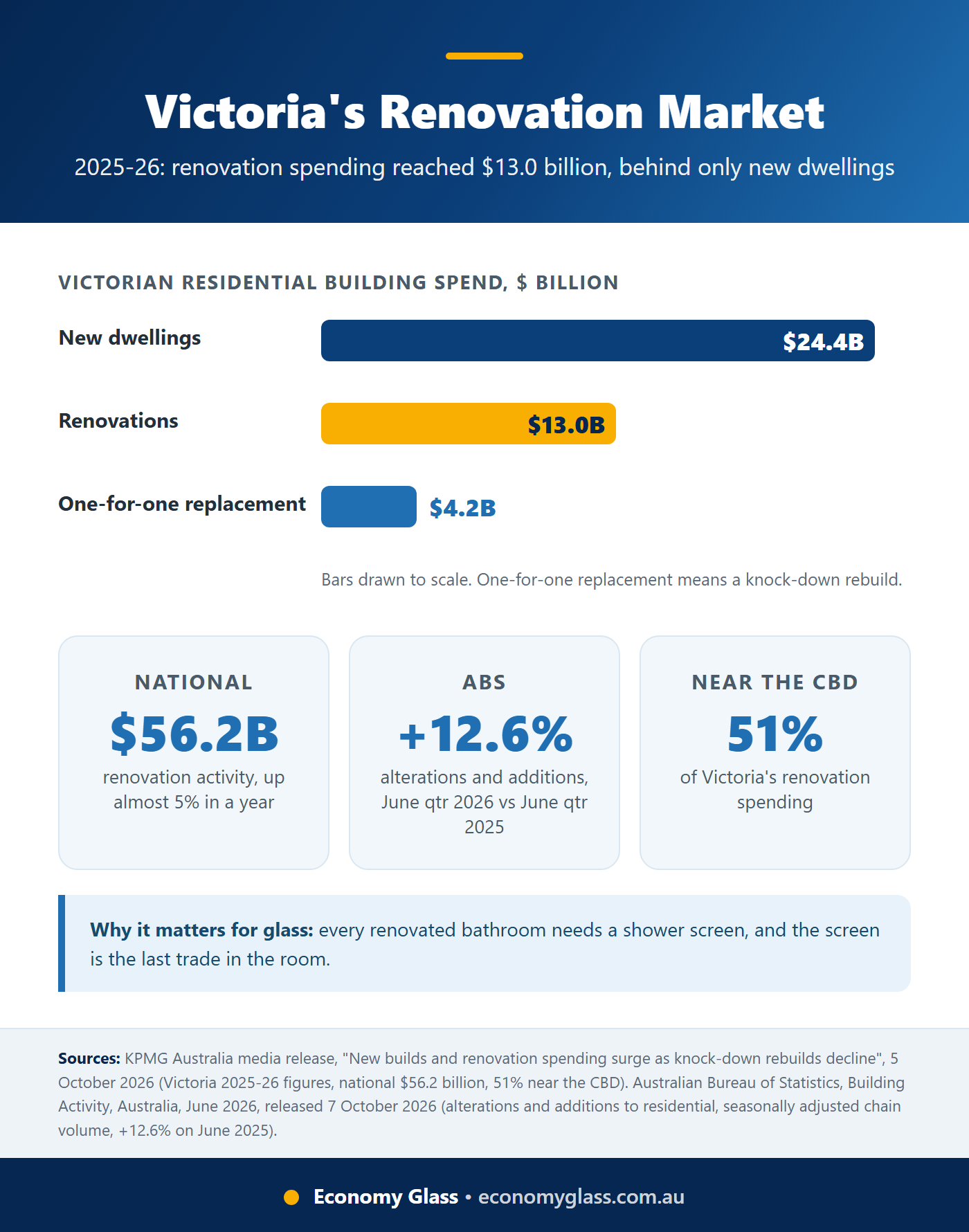
Renovating is still a big business in Victoria. The Australian Bureau of Statistics’ Building Activity release for the June 2026 quarter, published on 7 October 2026, puts alterations and additions to residential buildings at $4,119.0 million in seasonally adjusted chain volume terms, up 12.6% on the June 2025 quarter. KPMG Australia’s analysis, released on 5 October 2026, found Victorians spent $13.0 billion on renovations in 2025-26, compared with $24.4 billion on new dwellings and $4.2 billion on one-for-one replacement projects. Nationally, KPMG put renovation activity at $56.2 billion, up almost 5 per cent in the last year.
KPMG also found that areas close to Melbourne’s CBD account for 51 per cent of Victoria’s renovation spending, and it links that to older housing stock under heritage overlays and neighbourhood character controls, where extending and renovating is the practical way to get a new kitchen or bathroom. Melbourne’s west sits outside that inner ring, but the same logic holds for any house with an original bathroom.
Bathrooms are also getting tighter. At the March 2024 launch of the HIA Kitchens and Bathroom Report, HIA chief economist Tim Reardon said the size of a typical bathroom has fallen and that a large majority of bathroom jobs involved the same or even a smaller footprint. In a smaller bathroom the shower screen has to keep water in and still let the room feel open.
Where shower screens fit in the renovation sequence
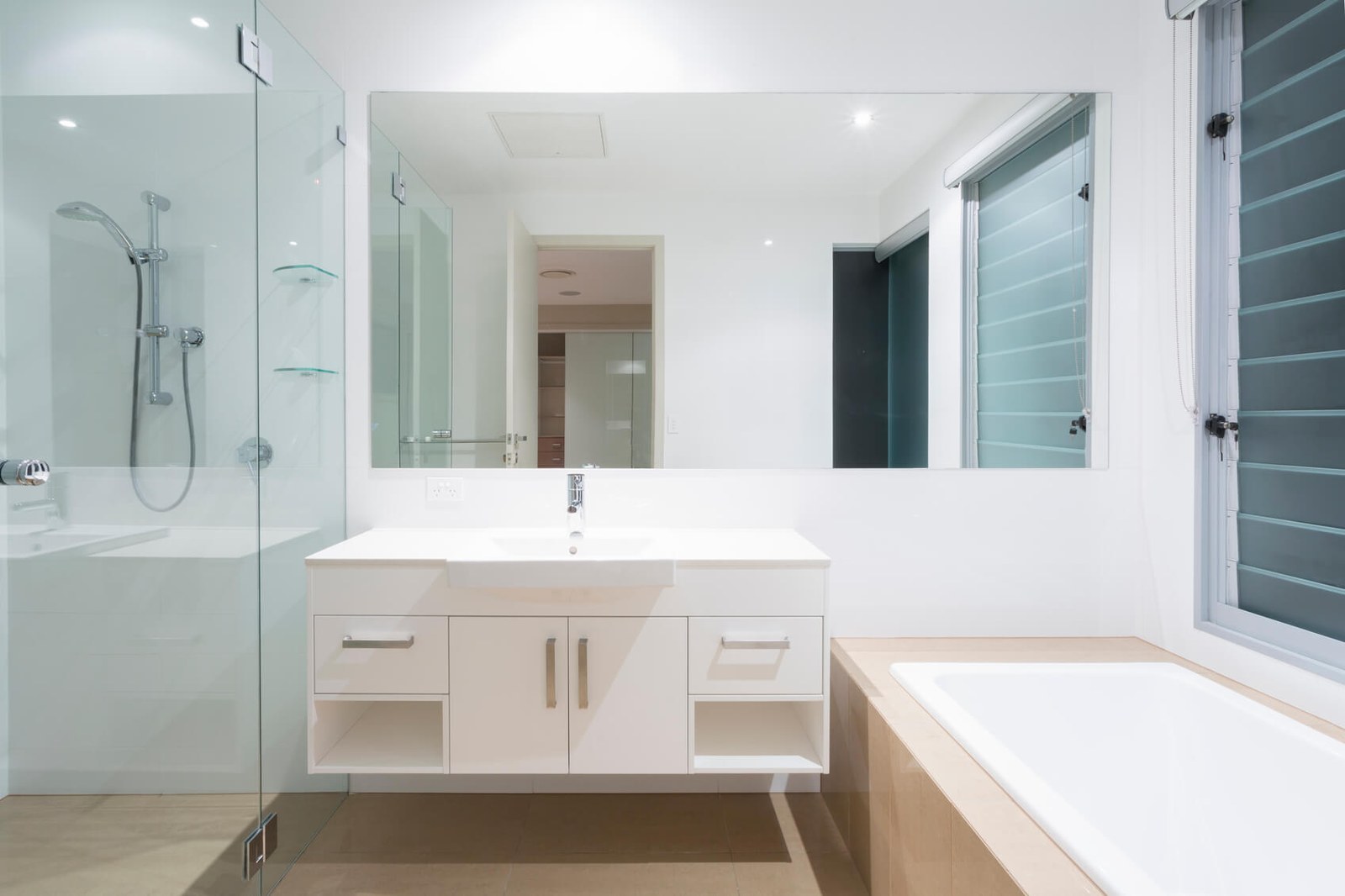
A bathroom renovation runs in a fixed order, and the shower screen sits near the end. The strip-out comes first, then framing repairs and wall linings, then the plumbing rough-in. Next comes the waterproofing membrane, the tiling and the grout. Only then does the glazier measure, the glass is made, and the screen is fitted and sealed.
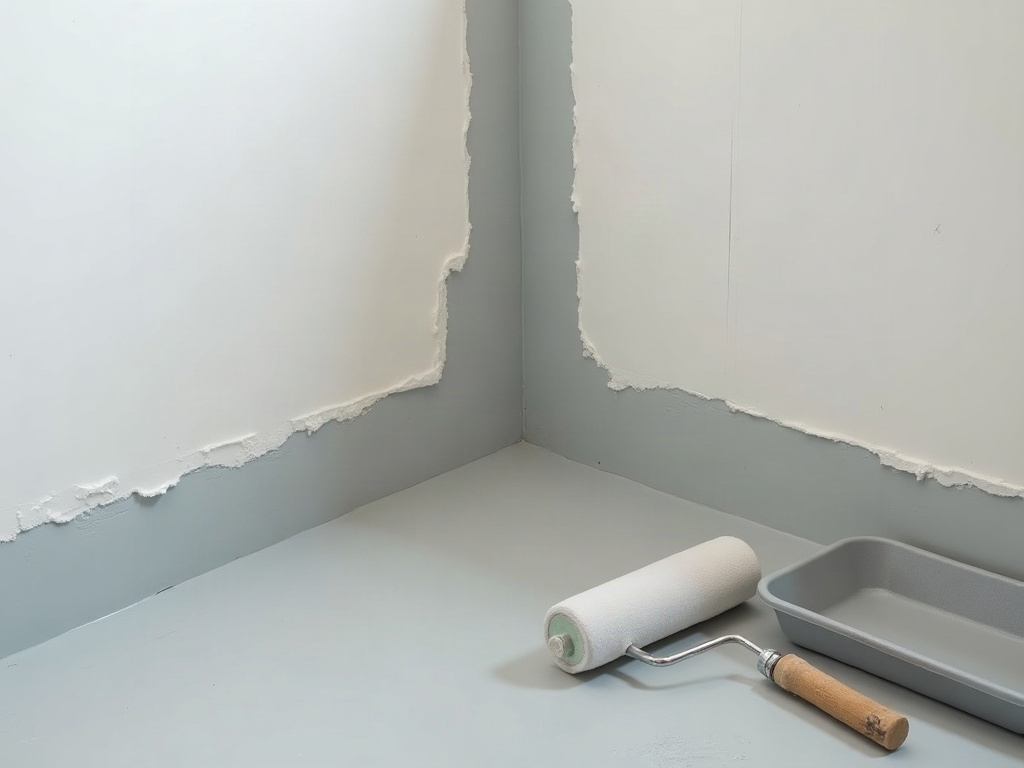
The reason the screen waits is simple. The Building and Plumbing Commission’s wet area guidance says the substrate has to be clean, dry and smooth before the membrane goes on, that residual moisture can stop the membrane curing or make it fail early, and that a visual inspection can be done before any finish is installed. Tiles and grout then cover the membrane for good.
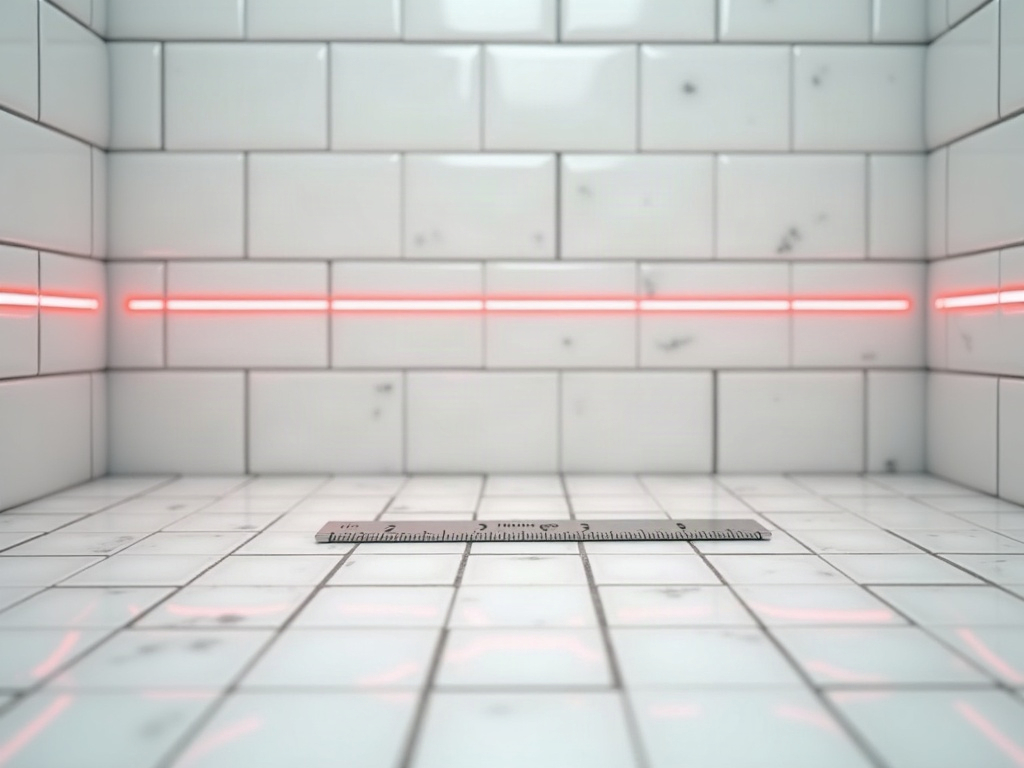
The glass has a second reason to wait. As we explain in our guide to custom made versus stock shower screens, we measure on site with a laser, and each panel of a custom screen is cut to those measurements. Toughened safety glass cannot be cut, drilled or altered once it has been made, so the measurement has to come from the finished tiled surface, where a few millimetres of tile and grout can change the width of a panel.
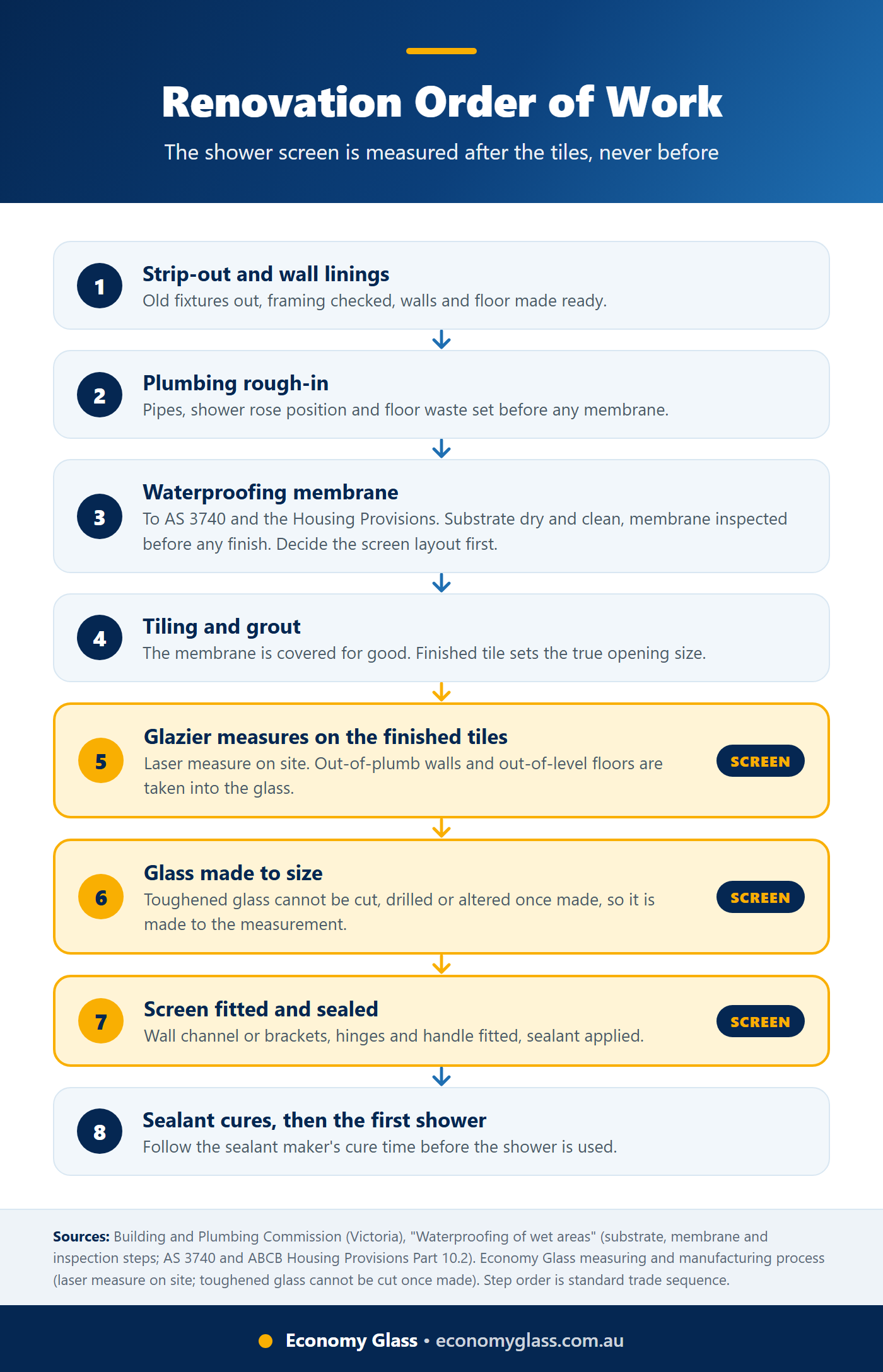
Plan the order with your builder and book the glazier early, because custom glass is made to measure after the tiles are finished and a bathroom waiting on glass cannot be used. Our page for bathroom renovation companies explains how that works for trade customers.
Waterproofing and AS 3740: what it means for your shower screens
The standard that governs waterproofing in a Victorian bathroom is AS 3740, Waterproofing of domestic wet areas. The Victorian Building Authority, now trading as the Building and Plumbing Commission, sets out the position in its wet areas guidance, which is written against the 2022 ABCB Housing Provisions: for Deemed to Satisfy compliance, waterproofing work must comply with AS 3740 or with Part 10.2 of the ABCB Housing Provisions, and where AS 3740 is used the material requirements of the Housing Provisions must still be followed. The current edition is AS 3740:2021, which the Housing Industry Association lists among its guides and standards.
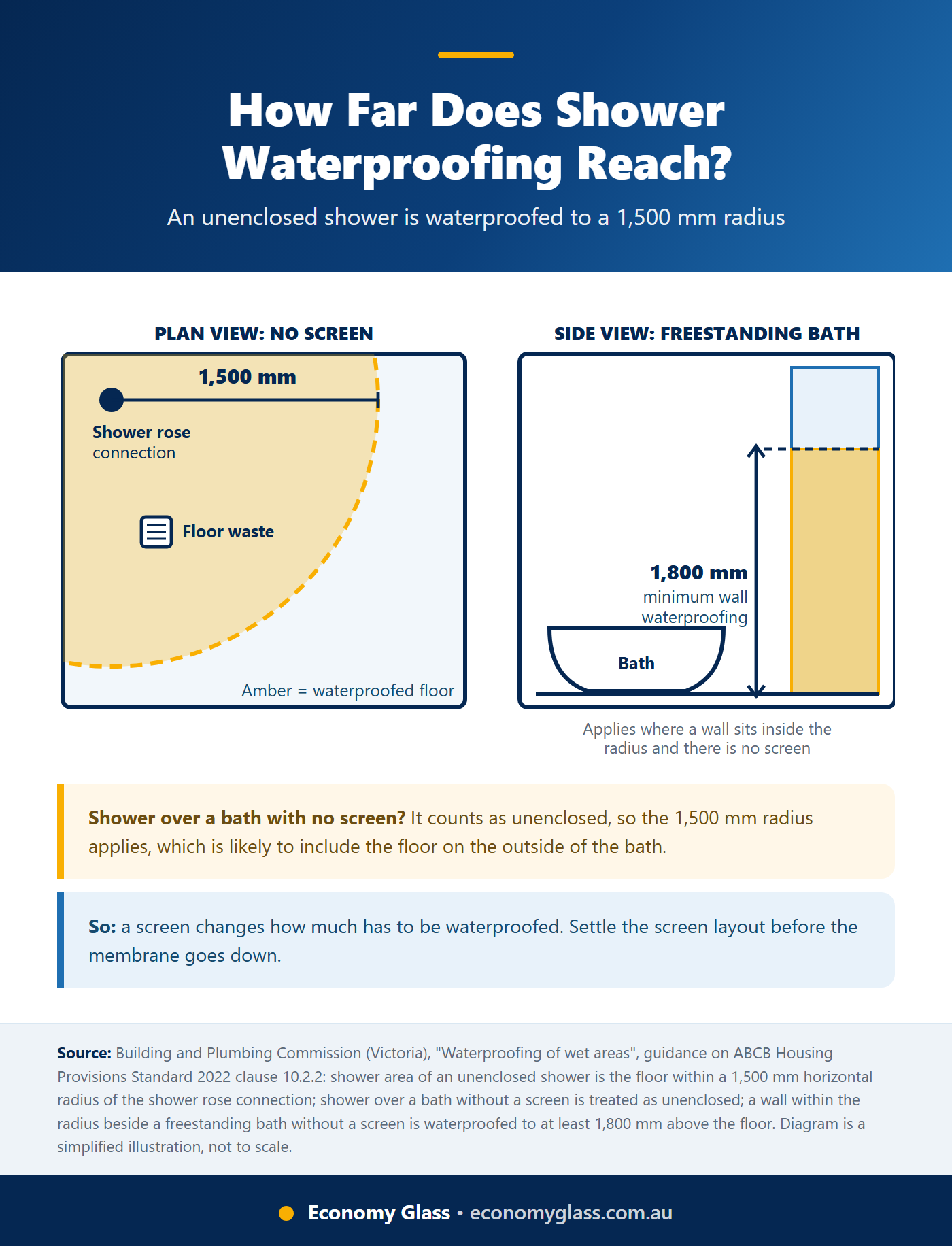
Here is the part that connects waterproofing to your screen. The Commission’s guidance says the floor of the shower area must be waterproofed, and for an unenclosed shower the shower area is the floor within a 1,500 mm horizontal radius of the shower rose connection. A shower over a bath without a screen is treated as unenclosed, so the waterproofing has to reach 1,500 mm out from the rose, which is likely to include the floor on the outside of the bath. Where a shower sits over a freestanding bath and any part of a wall falls within that radius without a screen, that wall must be waterproofed to at least 1,800 mm above the floor.
In plain terms: whether you have a screen, where it goes and how much of the room it encloses are waterproofing questions, not just design ones. Settle the screen layout before the membrane is applied. The Commission also states the shower floor needs a floor waste and a fall to it of between 1 in 80 and 1 in 50, so a screen that sits on that floor has to work with a surface that slopes.
A screen does not replace the membrane. Glass keeps splash in the shower; the membrane under the tiles protects the structure. The Commission describes compliant waterproofing as crucial to preventing moisture-related issues such as mould growth, structural damage and water infiltration into dry areas, and that job belongs to the membrane, the waterstops and the flashings, not to the glazier’s silicone.
Who does the work is a question for your builder and the regulator. The Victorian Building Authority’s registration pages list a Domestic Builder (limited) class covering bathroom, kitchen and laundry renovations, and the Commission publishes a tool to check a builder’s or plumber’s licence and a guide to which licence is right for the job. Ask the person managing your renovation who is waterproofing, which standard they are working to and what paperwork you receive. The glazier’s part is the last one: shower screens fitted to a finished, tiled shower.
Hobless showers, livable housing and the WELS star rating
Two sets of rules shape the shower itself before any glass goes in. The first is livable housing. Part H8 of NCC 2022 Volume Two requires a new Class 1a dwelling to have a shower that facilitates independent access and use, with the walls around it built so grab rails can be added later. The deemed-to-satisfy route is to comply with the ABCB Standard for Livable Housing Design. The Building and Plumbing Commission says Victoria’s livable housing provisions took effect on 1 May 2024, and the Victorian Government has described the standard as including step-free showers and reinforcement for grab rails.
Those provisions are written for new homes. If you are renovating an existing house, ask your building surveyor whether any of it applies to your job. Many renovators choose a step-free shower anyway, and DataForSEO’s Google Ads data puts “hobless shower” at about 880 searches a month in Australia.
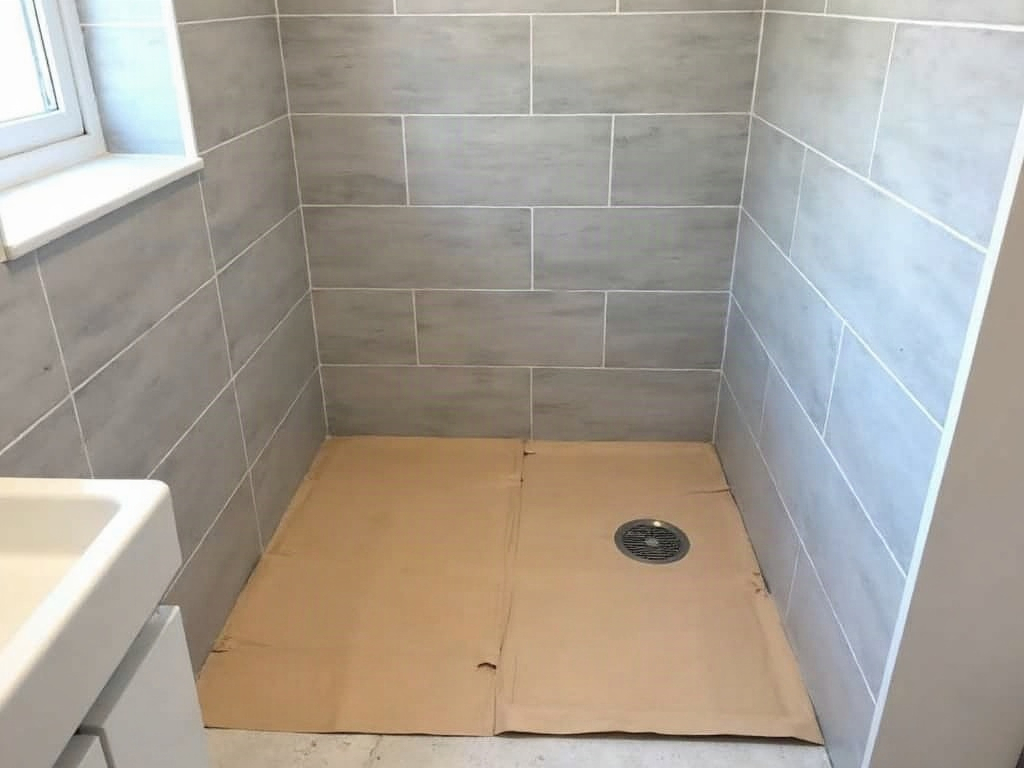
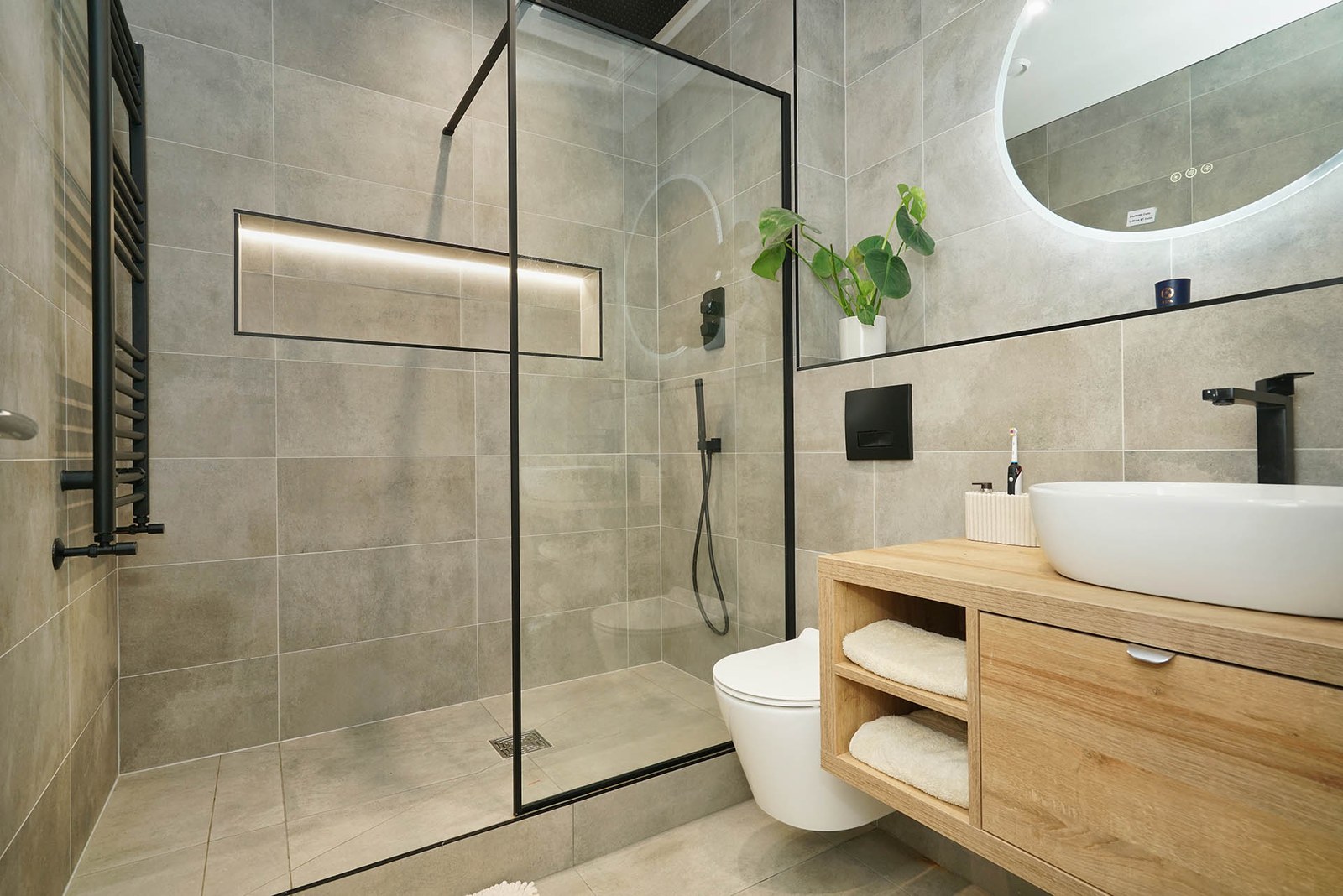
A hobless shower changes the glass job. With no hob to catch water, the fall of the floor, the waste position and the screen layout all decide where water ends up. A fixed panel with a sill-less opening, which means no bottom track or threshold, keeps the floor continuous. Economy Glass’s Evolution semi-frameless range lists a sill-less opening as a customisable option, and our frameless shower screens come as a fixed panel, a front and return, or a wall-to-wall layout, each made to the finished tile.
The second set of rules is water efficiency. The Australian Government’s Water Rating scheme (WELS) rates showers from 3 to 5 stars. Three stars, at more than 7.5 and up to 9 litres a minute, is the minimum required by the National Construction Code. Five stars, at more than 4.5 and up to 6 litres a minute, is the highest rating available for showers, and the scheme says a 5 star shower can save up to 50% of the water used by a 3 star one. Tell your glazier which showerhead you chose and where it points, because the spray decides how far the door has to overlap and whether a return panel is worth adding.
Safety glass and AS 1288: what shower screen glass has to be
Shower screens in Victoria have to use safety glass, and the rule behind that is AS 1288, the standard for selecting and installing glass in buildings. Viridian Glass’s May 2026 breakdown of the standard says it covers shower screens among other glazing, that compliance is required under the National Construction Code, that its appendices include shower screen installation guidance, and that overlooking safety zones in bathrooms is one of the common pitfalls for glaziers. Its human impact section identifies glazed areas likely to be hit by a person and points to tables of maximum areas and thicknesses for standard glass and Grade A safety glass.
Where wind load and human impact give different answers, the more stringent one applies. Viridian’s example is a wind-load minimum of 4 mm toughened against a human impact minimum of 6 mm, which makes 6 mm the compliant result. A glazier cannot simply pick the thinner panel.
Toughened glass does the heavy lifting in a bathroom. Viridian puts toughened glass at around 2.5 to 5 times the strength of annealed glass, and when it breaks the stress release makes the panel fragment into small granular pieces. The same article notes that the edges are by far the most vulnerable part of any glass panel, because chips and shells along an edge act as weaknesses. A chipped edge on an installed screen is therefore worth mentioning to your glazier.
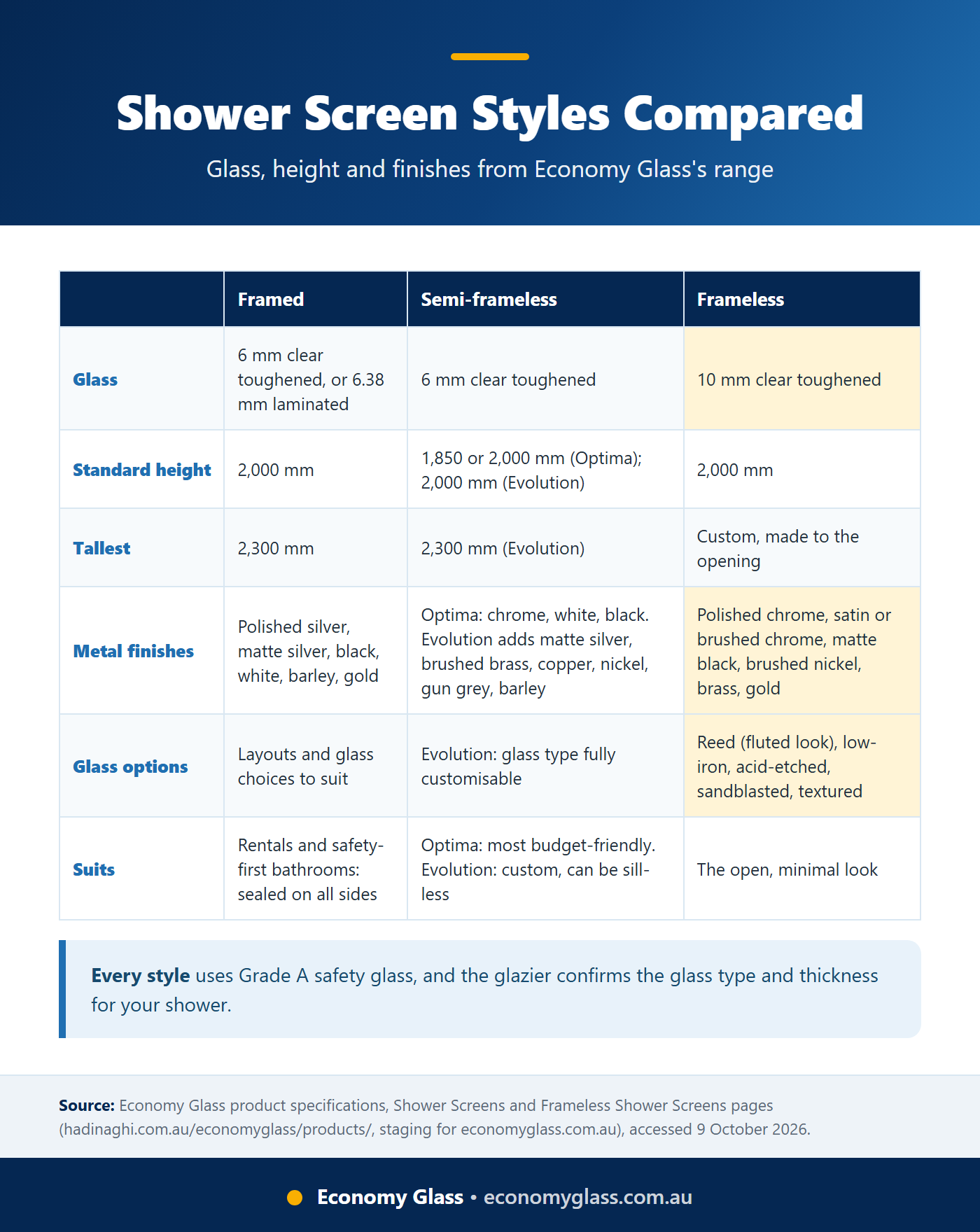
Our own specification is 10 mm clear toughened safety glass for frameless screens, 6 mm clear toughened for semi-frameless, and 6 mm clear toughened or 6.38 mm laminated for framed screens. Our standard screen height is 2,000 mm, with framed and Evolution semi-frameless screens available up to 2,300 mm. We determine the glass type and thickness for each job. For the difference between the two kinds of safety glass, read toughened vs laminated glass, and for the wider rulebook see our guide to safety glass in Melbourne homes.
To check the glass you already have, look for the permanent mark in a corner of each panel. If an older screen has no stamp, treat it as ordinary annealed glass until a glazier confirms otherwise. Our comparison of frameless vs semi-frameless shower screens covers the style decision.
Shower glass options: clear, low-iron, patterned and hardware finishes
Once the rules are met, the glass is a design choice. Economy Glass lists 10 mm clear toughened as the standard frameless option, and alongside it narrow reed glass for a fluted look, low-iron glass for truer colour, and acid-etched, sandblasted or textured glass for privacy. Clear glass has a slight green tinge from the iron in it, and low-iron glass removes most of that, which shows most against white tile and marble. Our guide to the glass types for shower screens goes through each finish in detail.
Patterned glass is where the interest is. DataForSEO’s Google Ads data for Australia, pulled on 9 October 2026, puts “fluted glass shower screen” at about 1,900 searches a month and “frosted glass shower screen” at about 590, so fluted and frosted panels are clearly on people’s minds. The trade-off is visibility: a patterned panel hides the person in the shower and shows less of the tile behind it, so use it where privacy matters.
Hardware matters as much as glass. Economy Glass lists polished chrome, satin or brushed chrome, matte black, brushed nickel, brass and gold hardware finishes for frameless screens, and says it can match them to taps, shower heads and towel rails. Semi-frameless frames come in colours from polished silver and white to black, brushed brass, brushed copper and gun grey. Pick the finish when you pick the tapware, and send your glazier a photo of the taps.
Melbourne’s soft water, soap scum and glass coatings
Most of Melbourne’s west has soft water, and that changes how shower glass gets dirty. The Australian Drinking Water Guidelines, published by the NHMRC, describe water below 60 mg/L of hardness as soft and 60 to 200 mg/L as good quality, with 200 mg/L as the aesthetic guideline value. Greater Western Water, which supplies much of Melbourne’s west, reported average hardness of 22 mg/L at Altona, 22 mg/L at Williamstown and 23 mg/L at Werribee in its 2023-24 drinking water quality report. Caroline Springs averaged 19 mg/L and Deer Park 23 mg/L. Hardness rises toward Bacchus Marsh, where Darley averaged 95 mg/L, but that is still under the 200 mg/L guideline value.
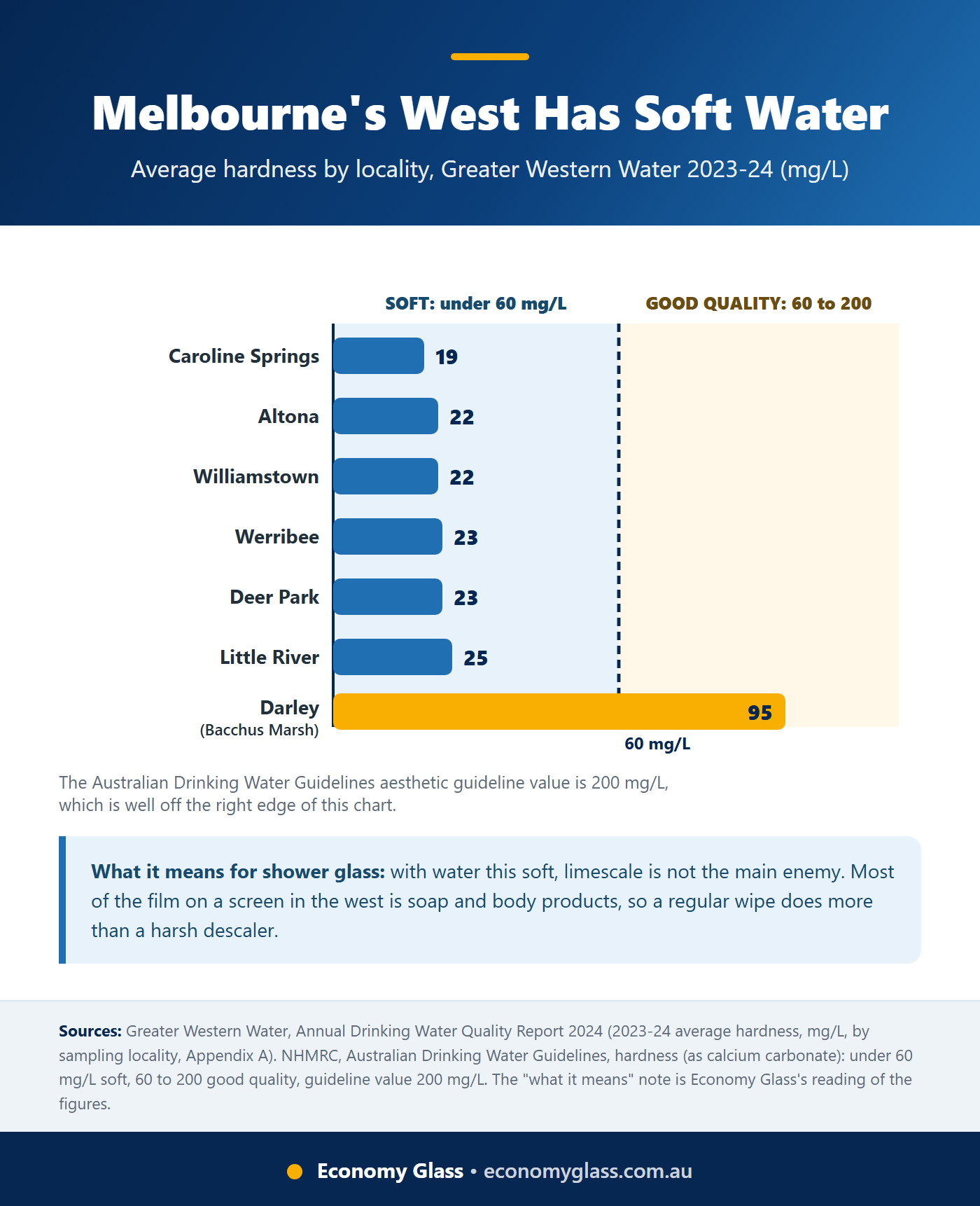
What this means for glass: limescale is not the main enemy in most of the west. The white film on a screen here is mostly soap, shampoo and body products, which is why a regular wipe does more than a harsh descaler. Our guide to how to clean your shower glass covers stubborn marks. That is our reading of the numbers, so outside the suburbs above, check your own supplier’s report.
Easy-clean coatings are the other half of the story. EnduroShield, the nano coating our earlier guide to EnduroShield easy clean glass coating describes, publishes its own claims, and they are the manufacturer’s, not ours. Its FAQ says treated shower glass should be cleaned weekly with a damp microfibre cloth and mild detergent, and that a squeegee is only needed daily in hard water areas. It describes the coating as two molecules thick and says accelerated testing that simulated cleaning a shower screen over a 10 year period left the coating still beading water and easy to clean. It also warns that rough, gritty or abrasive cleaners can damage the coating.
Sealing, leaks and what a leaking screen does to a bathroom
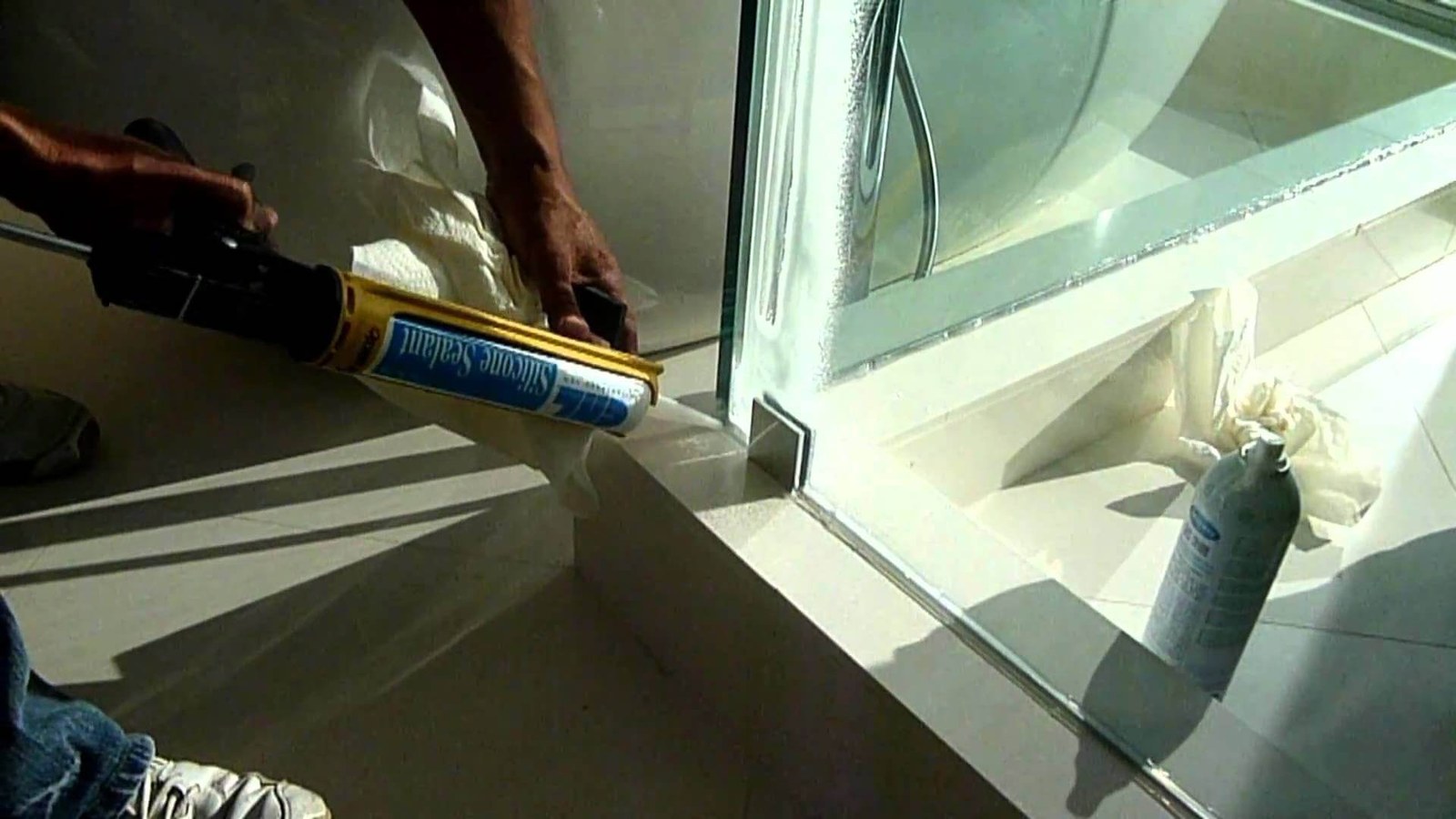
A shower screen leaks in three places: the seals, the hinges where a dropped door stops closing, and the base of the glass where the fall of the floor sends water the wrong way. The Building and Plumbing Commission’s guidance says all sealants in a wet area must be waterproof or water resistant where permitted, flexible, mould resistant and compatible with adjacent materials. That is a good checklist for any silicone on a screen.
Silicone is the weakest part. Our guide to neutral cure and sanitary silicone explains why bathrooms need sealant with a mould inhibitor, and an earlier Economy Glass installation tips post puts the life of silicone in a shower at approximately 10 years before it can degrade, discolour or break down. Where we fit a wall channel instead of brackets, there is little exposed silicone to fail, because the channel covers the full edge of the glass.
A leaking screen does damage in stages. First, water that was meant to stay inside the shower area ends up on the floor outside it. Then it works into the skirting, the door jamb and the adjoining room. The silicone darkens, and black mould in the grout and at the base of the glass follows. The Commission lists mould growth, structural damage and water infiltration into dry areas as the outcomes waterproofing exists to prevent, and a long-running screen leak is one way to meet all three.
Insurance deserves a mention. Finder’s guide to shower leak insurance, updated on 15 April 2026, says home insurance generally covers sudden, unforeseen shower leaks such as a burst pipe but excludes gradual damage or poor maintenance, and tells owners to check the Product Disclosure Statement for terms such as water damage or escape of liquid. insuranceNEWS reported in June 2020 that bathroom leaks have triggered dozens of disputes at the Australian Financial Complaints Authority, including a Suncorp case where the policy excluded leaking showers. A screen that drips for months is the gradual case. Fixing it promptly protects both the floor and your claim.
Repair or replace: how to decide
The decision comes down to what has failed. Economy Glass’s shower screen repairs page sets it out: toughened glass cannot be repaired once it has cracked or shattered, so the panel is remade to size and refitted. If the frame and hardware are sound, we can often replace a single panel made to match the existing glass. For frameless screens we can sometimes replace worn hinges, handles or rollers without new glass, but where hardware keeps failing a full replacement is usually the better long-term fix.
Leaks are the clearest case for replacement. We do not re-silicone old screens. Where the seals have gone, a new screen with wall channels is the lasting fix. If a door has dropped, we replace the door and fit hinges built for the weight. And if the frame is corroded and the seals have failed as well, a full new screen is usually the best option. We tell you which applies before you commit.
Our guide to shower screen replacement walks through the seven signs in order and what happens on the day, and our shower screen glass replacement and repairs page shows the process from photo to fitted glass.
Older homes in Melbourne’s west: asbestos, out-of-square walls and old screens
Older bathrooms bring their own checks. Asbestos Victoria’s fact sheet for homeowners and tenants says asbestos is commonly found in many homes built before 1990, lists interior walls including behind ceramic tiles and splashbacks among the places it turns up, and gives a golden rule: if you think it might be asbestos, treat it like it is. Fixing a screen’s wall channel means drilling into the wall, so tell the glazier, and your builder, if the house predates 1990 and you do not know what is behind the tiles.
Old houses also have walls that lean and floors that fall. A stock screen comes in set sizes and has to absorb that in packers, hardware or silicone. Our custom-made screens take the wall and floor tolerances into the glass itself, which is how a screen sits flush on a wall that is out of plumb. Semi-frameless suits a lot of older bathrooms because the frame forgives small variations, while a fully framed screen is a sturdy choice for rentals because it is sealed on all sides.
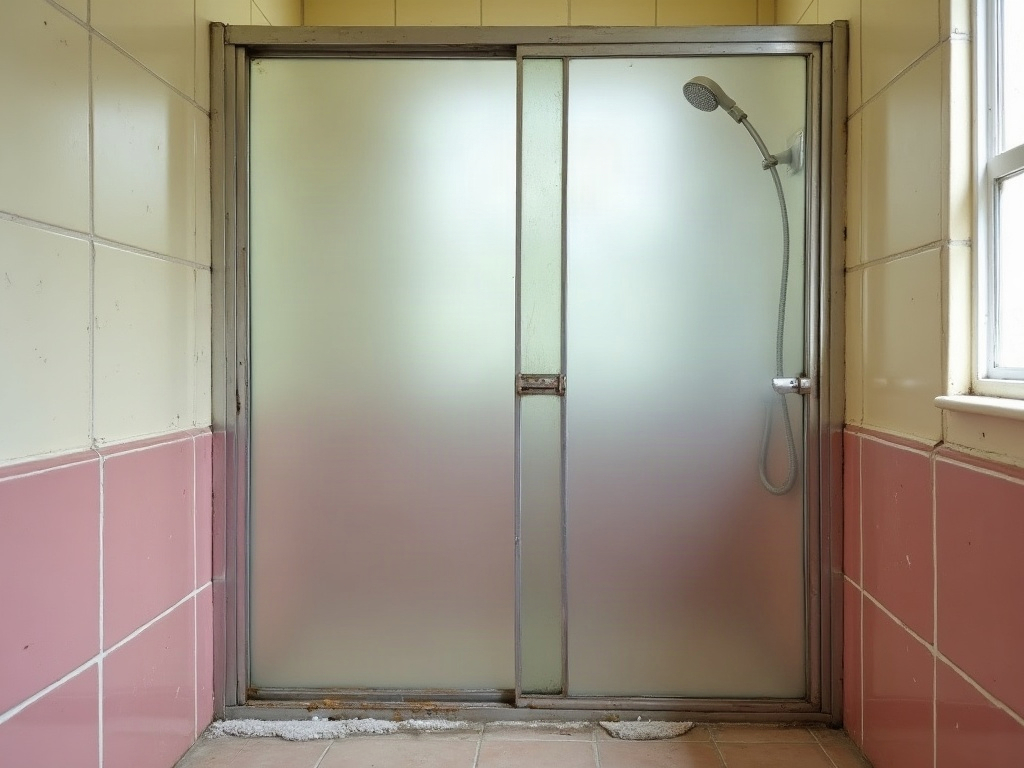
If you are planning a glass splashback elsewhere in the bathroom, our glass splashbacks are made to size in plain and coloured glass. The same measure-after-the-wall-is-ready logic applies.
Talk to a glazier
Measuring, cleaning the glass, checking for a safety stamp and tightening a loose handle are all things you can do yourself. Cutting glass, replacing a panel, fitting hardware to toughened glass and fixing a screen to a wall belong with a glazier, because the glass has to be the right type, made to size and fitted to the standard.
That is where Economy Glass comes in. Economy Glass supplies and installs shower screens across Melbourne’s west and beyond from our Hoppers Crossing workshop, with 45 years in the glass trade and glass cut and finished to Australian Standards. Call (03) 9360 9900, Monday to Friday 8am to 4pm, or request a quote online.
Frequently asked questions
Who installs shower screens?
Is the shower screen measured before or after tiling?
Do you need a building permit for a bathroom renovation in Victoria?
How much does a shower screen cost?
Do frameless shower screens leak?
What is a hobless shower?
How do I clean a shower screen?
How do I know when to replace a shower screen?
Want the detail on each decision? Read our companion guides on shower screen replacement and frameless vs semi-frameless shower screens, or request a quote from Economy Glass.