



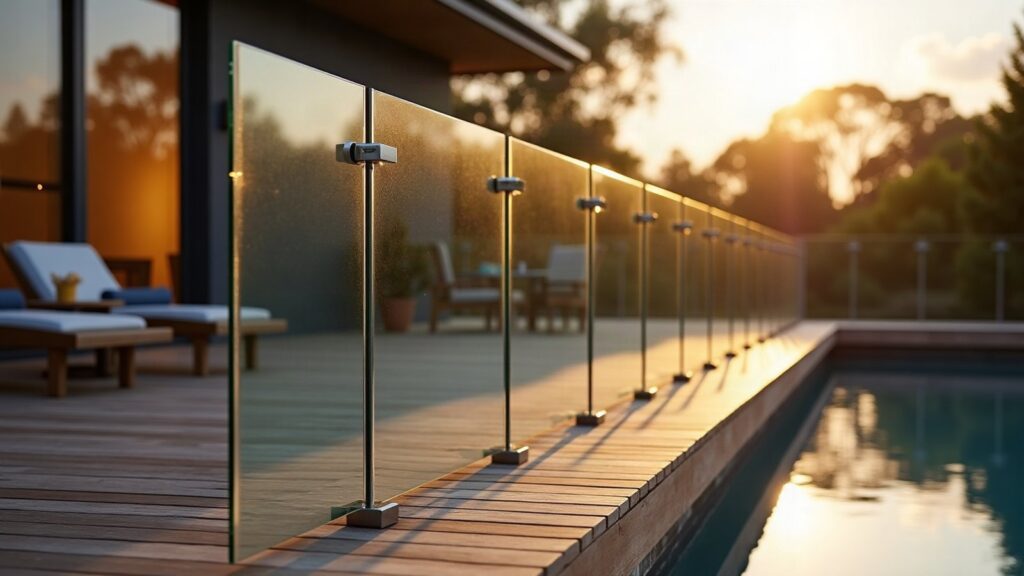
A frameless glass balustrade is held only at its base or its side, by spigots, a channel or pins, with no posts between the panels. A semi-frameless balustrade adds posts, and a framed one surrounds the glass with posts and rails. That is the whole difference in one sentence, and it decides the look, the hardware, the rules the glass has to meet and how much upkeep the balustrade needs. Frameless glass balustrades give the clearest view, but they ask the most of the glass and the fixing. This guide compares each system so you can choose with confidence. For standards, glass thickness and balcony rules, see our full glass balustrade guide for Victoria.
Frameless, semi-frameless and framed: the short answer
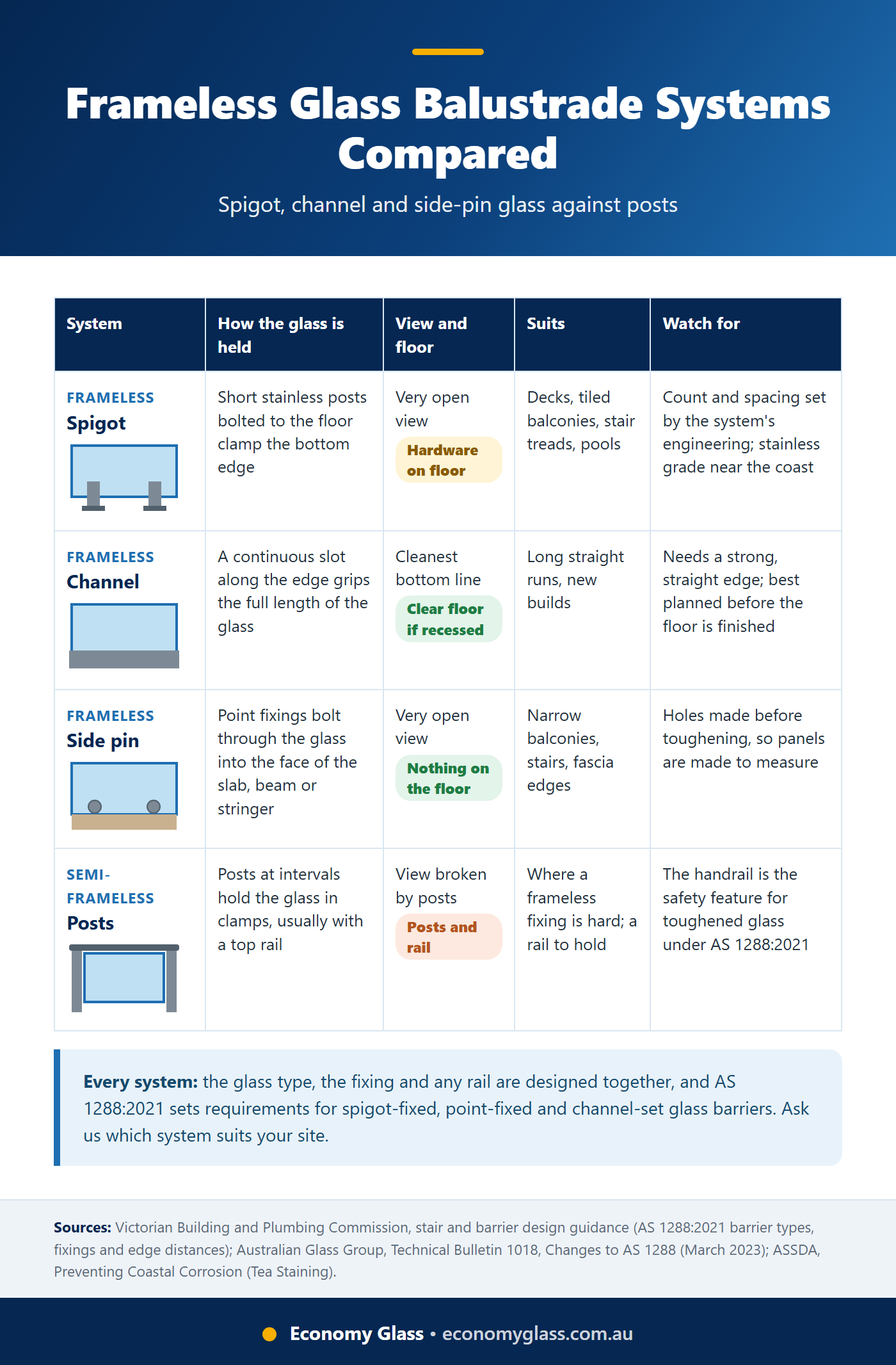
Frameless: the glass stands on its own, fixed at the bottom or the side, with gaps between panels. The Victorian Building and Plumbing Commission (BPC) describes these as spigot-fixed, point-fixed and core-drilled barriers, and barriers set in fixing channels.
Semi-frameless: posts carry the glass in clamps between them, usually with a rail on top. You still see through the glass, but the posts break up the view.
Framed: the glass is an infill inside a frame of posts and top and bottom rails, often aluminium. The BPC lists posts, top and bottom rails and connection plates among the components of proprietary glazing systems that must comply with AS/NZS 1170.1, the Australian loading standard.
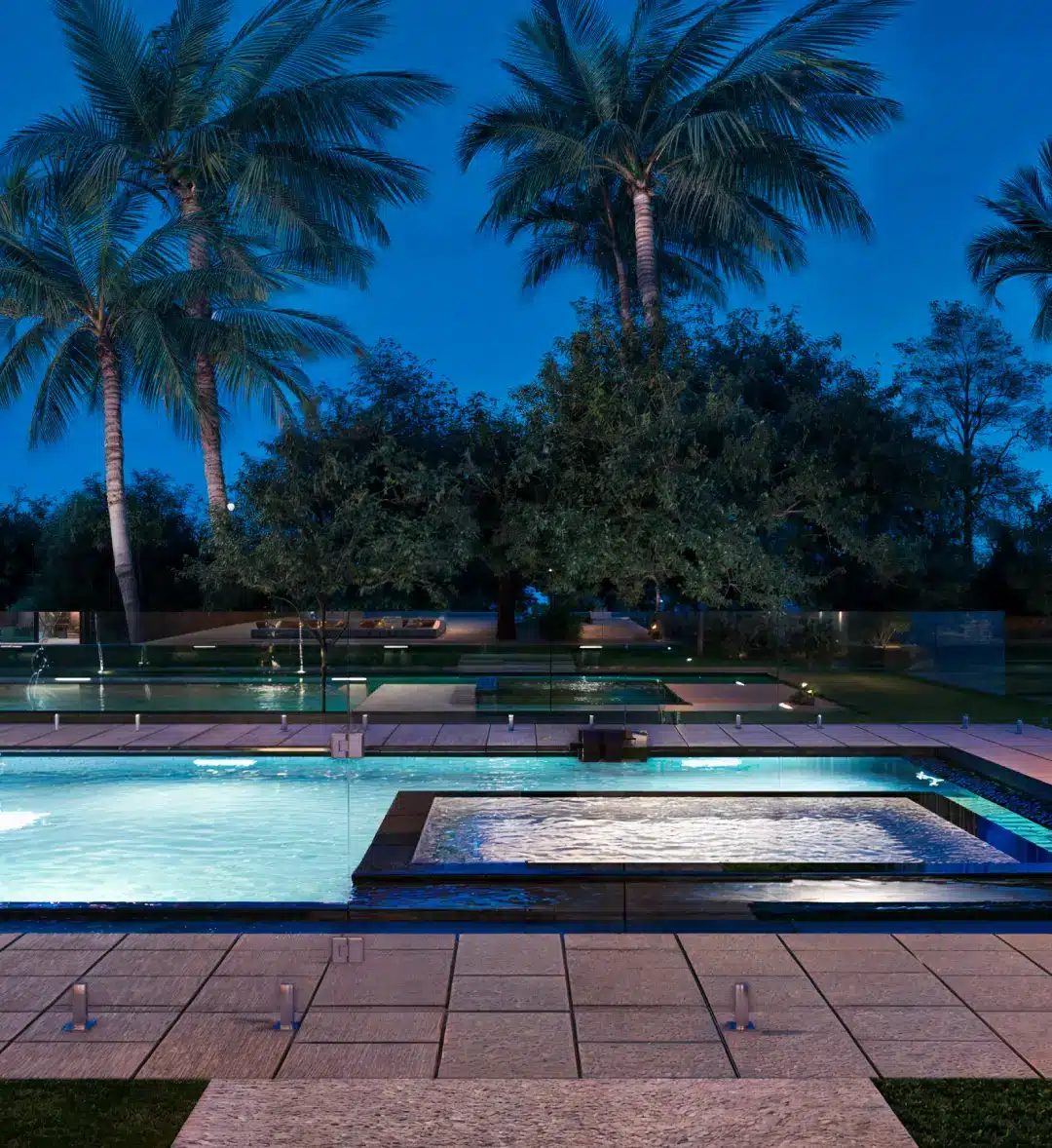
The same systems turn up around pools, so if you have seen spigots on a glass pool fence, you already know the look. A balustrade has a different job, though: it is a barrier designed to stop a fall from height, so its height and load rules come from the NCC barrier provisions.
Frameless glass balustrades: three ways to hold the glass
Every frameless system relies on one fixing detail to carry the load. The BPC says AS 1288:2021, the Australian Standard for glass in buildings, sets detailed requirements for spigot-fixed, point-fixed and core-drilled barriers and the use of fixing channels where the glass has no handrail or a non-load-supporting handrail.
Spigot mounted glass balustrades
Spigots are short stainless steel posts bolted to the floor or deck that clamp the bottom edge of the glass. They suit decks, tiled balconies and stair treads. The trade-off is hardware on the floor, which you sweep and wash around.
Channel mounted glass balustrades
A channel is a continuous slot along the edge, either on the surface or recessed into the floor, that grips the full length of the glass. Nothing breaks up the bottom line, so a recessed channel gives the cleanest result of all. It needs a strong, straight edge to fix to and is best planned before the floor is finished.
Side pin mounted glass balustrades
Side pins, also called standoffs or point fixings, bolt through holes in the glass into the face of the slab, beam or stair stringer. The floor stays completely clear, which suits narrow balconies and stairs. Holes are drilled before the glass is toughened, because toughened glass cannot be cut or drilled afterwards, so every panel is made to measure.
Glass balustrade spigots: what to ask before you choose them
How far apart should spigots be? There is no single number. The BPC says the designer must choose fixtures based on the substrate and the manufacturer’s specification, and must maintain minimum edge distances and spacing between fixings in the barrier and in the material it is fixed to. So the number of spigots for each glass balustrade panel, and their spacing, is set by the engineering for that glass, that height and those loads. The Australian Glass and Window Association (AGWA) says there is no deemed-to-satisfy solution for spigot systems in AS 1288, so an engineer designs the barrier, with or without a handrail, or the system is tested to show it passes the loading requirement.
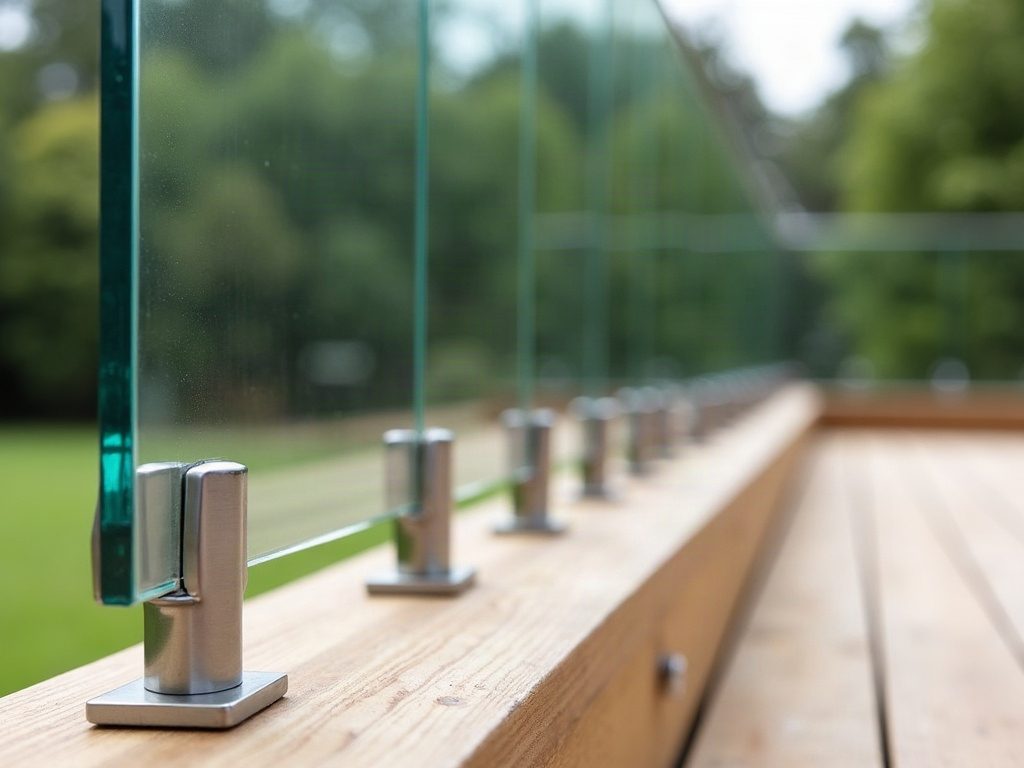
Grade and finish matter outdoors. The Australian Stainless Steel Development Association (ASSDA) says tea staining is most common within about five kilometres of the surf, and that Grade 316 or equivalent should be the minimum in that zone. ASSDA also says a mirror polish is the most corrosion-resistant mechanical finish. The BPC’s barrier guidance points to Grade 316 for marine or corrosive environments too. In bayside suburbs, ask what grade and finish the spigots are, and wash them whenever the glass needs washing, which is ASSDA’s rule of thumb.
Frameless glass balustrade channel: when it suits
A glass channel suits long straight runs, modern builds and anywhere you want the floor line completely clean. Australian Glass Group’s technical bulletin on AS 1288:2021 lists glass structurally siliconed into a glazing channel system as one of the safety features a laminated barrier can rely on when a pane breaks. That is the key point with channels: the glass type, the channel and the way the glass is set in it are specified together.
Channels are less forgiving on existing decks and balconies. If the edge is not straight or strong enough, spigots or side pins may be the better fit. Ask us which system suits your deck or balcony.
Semi frameless glass balustrade: posts, clamps and a rail
A semi frameless glass balustrade uses posts at intervals with the glass held in clamps between them, and a rail on top of the posts. It is a practical choice where a frameless fixing is hard to achieve, and the rail gives you something to hold. Under AS 1288:2021, Australian Glass Group says the handrail is the safety feature for monolithic toughened glass: after one pane breaks, the handrail and the remaining panes must carry the service loads.
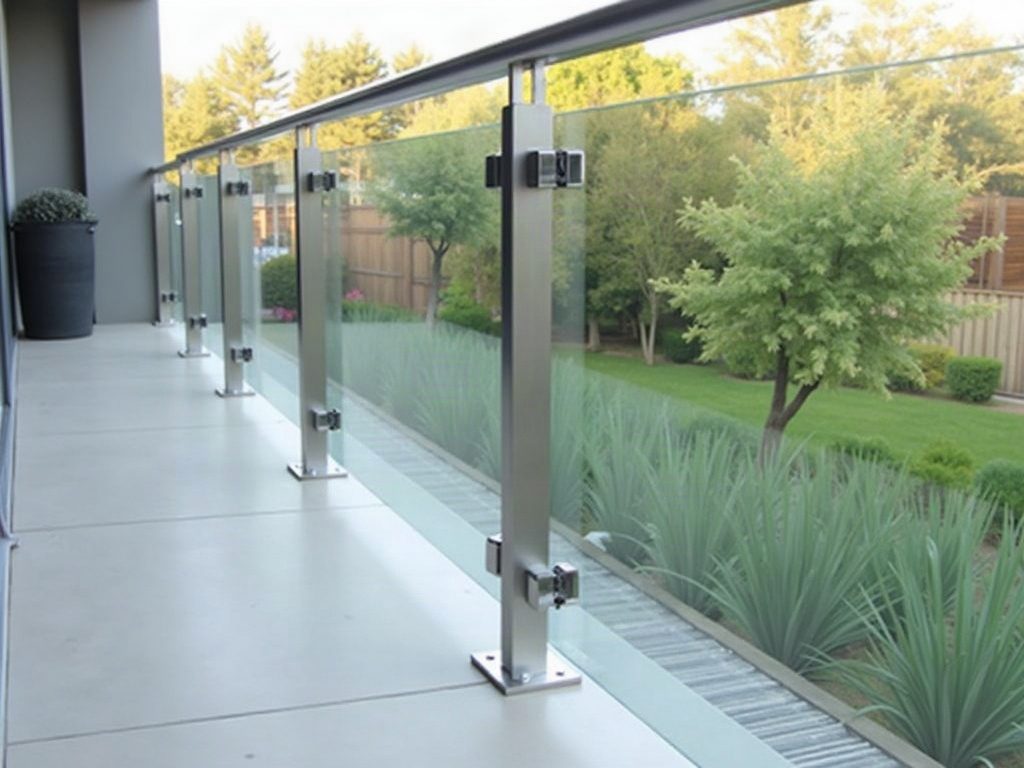
Framed glass balustrade
A framed glass balustrade sets the glass inside a full frame of posts and top and bottom rails. It has the most metal and the least open view, but the frame holds the glass on every side. It suits busy areas and owners who prefer a traditional railing look with glass infill.
Aluminium and glass balustrades
Aluminium and glass balustrades are usually framed or semi-frameless systems with powder-coated aluminium posts and rails. The powder-coat colour can be chosen to suit the house, which is a big part of their appeal. As with any proprietary system, the BPC says the posts, rails, connection plates and bolts must comply with AS/NZS 1170.1.
The rule behind every system: what happens if a pane breaks
AS 1288:2021 changed how glass barriers are judged. Australian Glass Group says the standard now focuses on the barrier system after a component has failed. For monolithic toughened glass, the safety feature is the handrail. For laminated glass with a regular interlayer, it can be a handrail, clips to adjacent panes or structural silicone in a channel. AGWA notes that a barrier protecting a height of more than 5 m must be Grade A laminated safety glass under AS 1288:2021. Our guide to toughened vs laminated glass explains the two glass types.
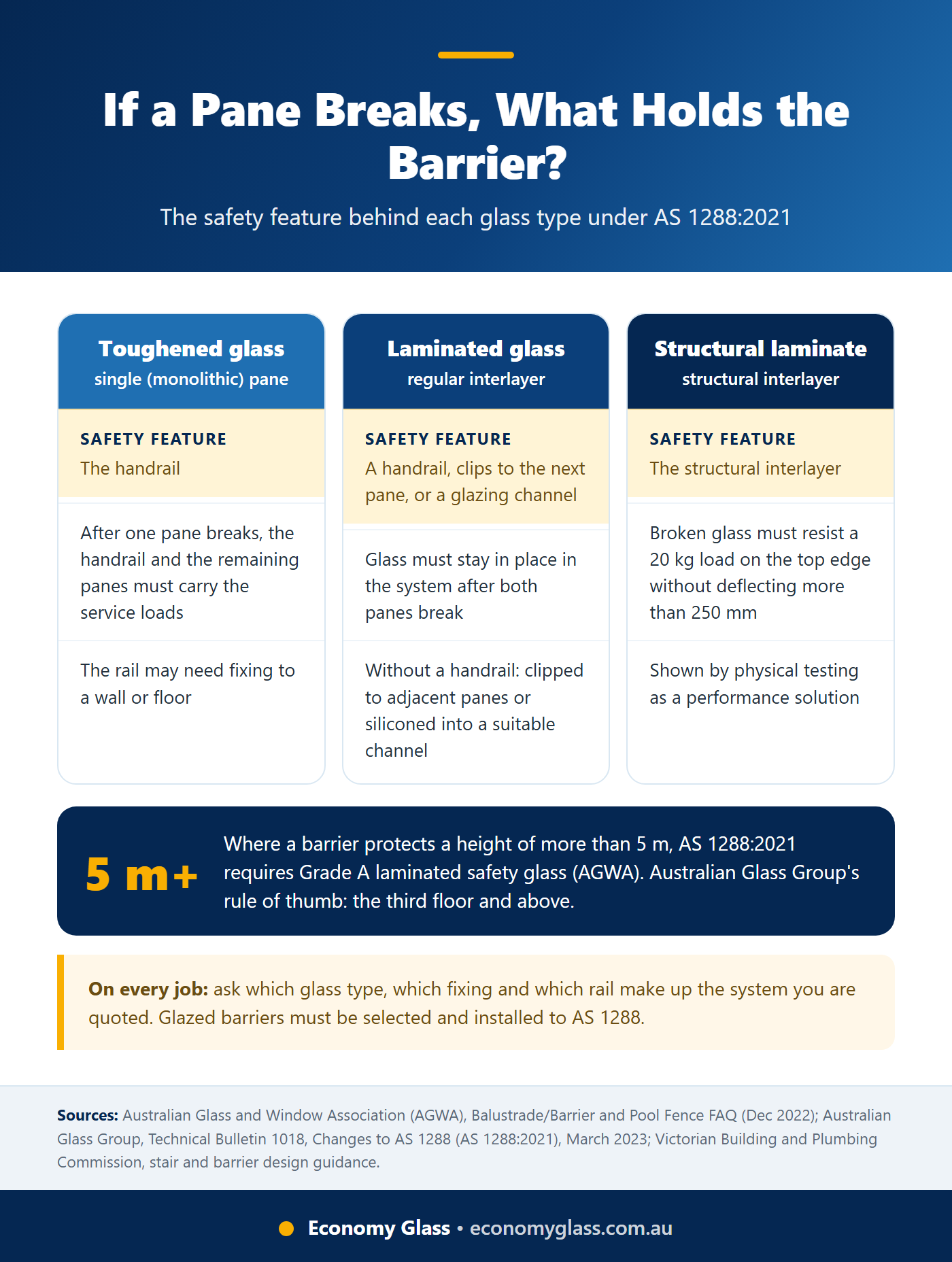
For a balustrade of 1 m or more, the BPC reminds practitioners that AS 1288:2021 has expanded requirements for structural glass barriers with interlinking handrails and for those with no load-supporting handrail. In practice, that means asking which glass, which fixing and which rail make up the system you are being quoted. Economy Glass installs toughened safety glass to Australian Standards. If your project is a staircase, our guide to a glass balustrade on stairs covers the height and handrail rules for stairs.
What changes the price of a glass balustrade
Economy Glass does not publish prices, because every balustrade is measured first. These are the factors that move a glass balustrade cost up or down:
- The system. Spigots, channel, side pins, posts or a full frame each use different hardware and fitting time.
- The glass. Type, thickness and size, and whether laminated glass is required for the fall height.
- Shape and length. Corners, raked stair panels, junctions with walls and short panels all add measuring and fitting.
- What it fixes to. Concrete, timber or steel, and whether the edge needs work before it can take the fixings.
- Hardware grade and handrail. Stainless grade and finish near the coast, and whether a top rail or grab rail is included.
- Access and paperwork. Upper-floor access, and any engineering certificate your building surveyor asks for.
Ask each installer to name the system, glass type and thickness, hardware grade and handrail in writing, so the quotes compare like with like.
Talk to a glazier about your balustrade
That is where Economy Glass comes in. Economy Glass supplies and installs glass balustrades for stairs, decks and balconies across Melbourne’s west and beyond from our Hoppers Crossing workshop, with 45 years in the glass trade and glass cut and finished to Australian Standards. A variety of finishes and fixtures is available. Call (03) 9360 9900, Monday to Friday 8am to 4pm, or request a quote online. For a balustrade, the balustrade and pool fence quote form lets you send photos and measurements, and we will book a free measure.
Frequently asked questions
How far apart should spigots be on a glass balustrade?
Are glass balustrades safe?
Are glass balustrades expensive?
How do you install a frameless glass balustrade?
Can I install a DIY glass balustrade?
What are the regulations for frameless glass balustrades in Australia?
What type of glass is best for balustrades?
Keep reading: our glass balustrade guide for Victoria brings the standards, glass types and balcony rules together, and our guide to a glass balustrade on stairs covers stair heights, handrails and raked glass.