



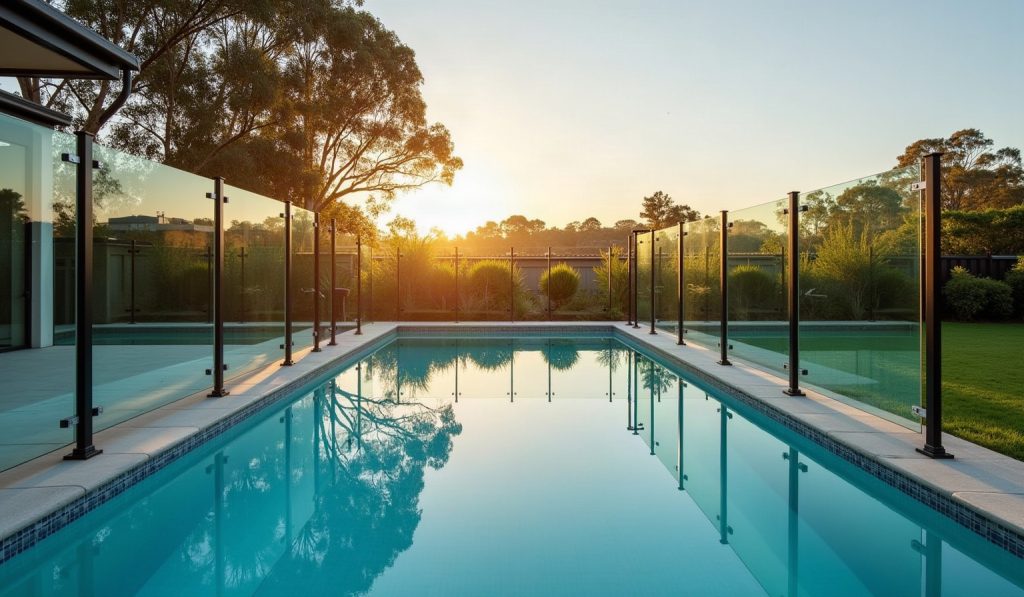
Glass pool fencing is legal in Victoria, it is common, and it passes inspection every day, provided it is built to the same barrier rules as any other pool fence and made from Grade A safety glass. The rules that matter are short. Any pool or spa that can hold more than 30 cm of water needs a compliant barrier. The pool must be registered with your council. A registered inspector must certify the barrier every four years. And the owner, not the glazier and not the builder, carries that duty for as long as they own the property.
This guide covers 2026 for homes in Melbourne’s west and across Victoria: what the Building and Plumbing Commission requires, how AS 1926.1 and AS 1288 fit together, what fails inspections, what to do about a cracked pane, and how to keep glass clear in hard water and salt air. Economy Glass supplies and installs glass pool fencing from our Hoppers Crossing workshop. We do not inspect or certify barriers, and this guide is clear about who does.
Why Victoria regulates glass pool fencing so tightly
The rules exist because of children, so it is worth starting with the numbers, handled with the care they deserve. Royal Life Saving Australia’s National Drowning Report 2025, released on 26 August 2025, recorded 15 drowning deaths among children under five, 21% below the ten-year average, and half of those deaths were in home swimming pools. The same release urged pool owners to check that their pool fence and gate are in good working order. In the Victorian toll, Life Saving Victoria’s 2024-25 Drowning Report counted 52 drowning deaths across the state, including seven fatal drownings in home swimming pools and retirement village pools.
The trend is moving the right way. Australasian Leisure Management and Country News reported that the National Drowning Report 2026, released on 10 September 2026, found 11 deaths of children under five, 39% below the ten-year average. Australasian Leisure Management added that 55% of those were in backyard pools.
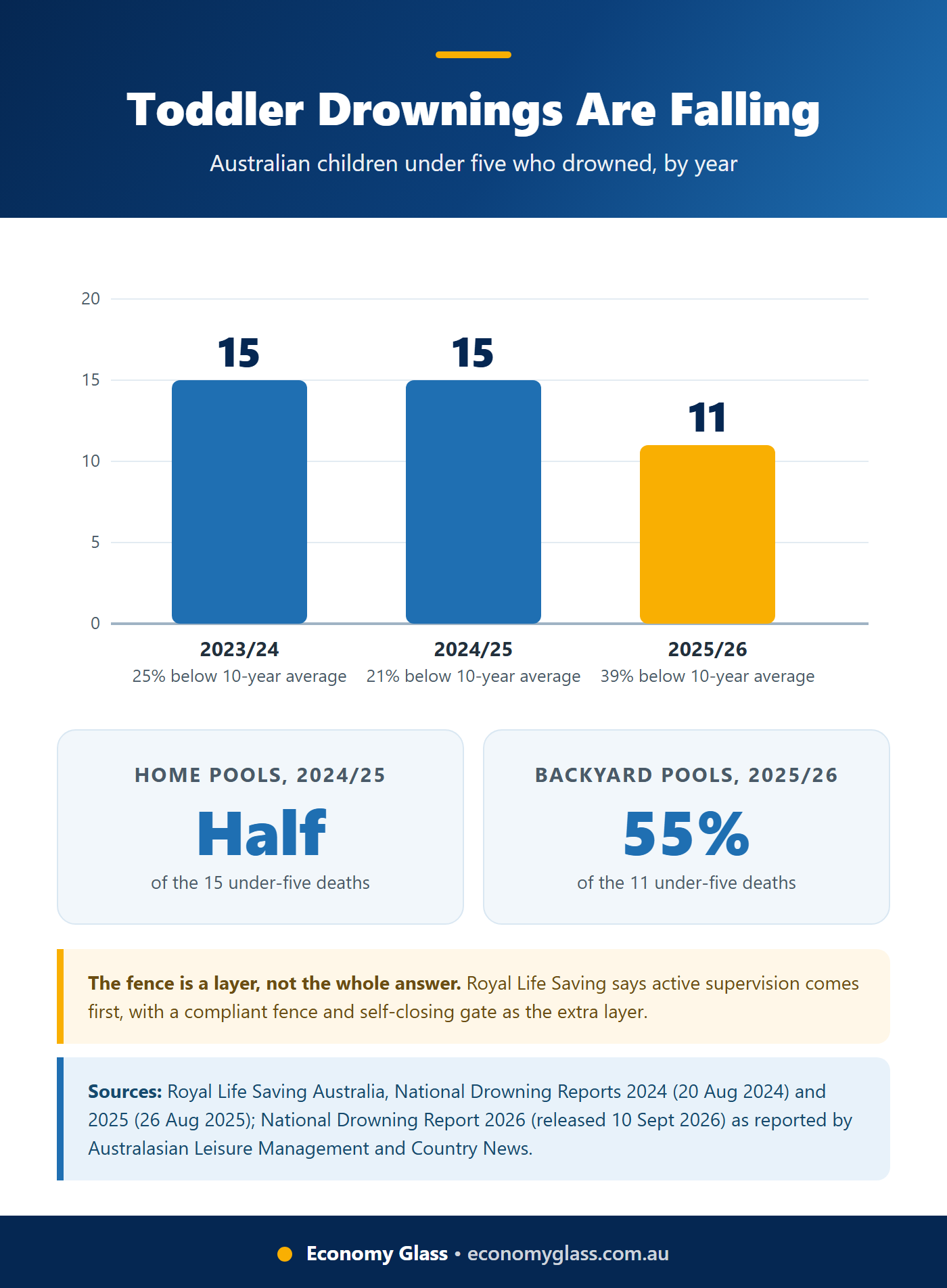
Royal Life Saving is blunt about what a fence does and does not do. Its 3 September 2024 release says effective adult supervision is the most critical factor, and that because backyard drownings often follow a lapse in supervision, the pool fence and gate are critical. Its 24 September 2025 Keep Watch advice calls a compliant fence with a self-closing, self-latching gate a vital extra layer for the moments when life interrupts. Kidsafe Victoria’s Layer Up This Summer campaign pairs barriers with supervision, swimming skills and CPR, and says a large number of child drowning deaths involve faulty or non-compliant barriers.
Glass pool fencing rules in Victoria: what the regulator requires
Victoria’s pool regulator is now the Building and Plumbing Commission, which took over from the Victorian Building Authority on 1 July 2025 and still trades under the Authority’s legal name. Its pages, last updated on 30 June 2026, set out the basics. All landowners must register any pool or spa on their property with their council and keep a compliant safety barrier in place, whether or not children live there. The rule applies to every pool or spa capable of holding more than 30 cm of water, including in-ground, above-ground, indoor and relocatable pools and inflatables that need assembly on site.
For the barrier itself, the Commission says Victoria’s Building Regulations 2018 require gates that are self-latching and self-closing, and that the barrier comply with the barrier standard, AS 1926.1. Councils give the numbers. Knox City Council’s fact sheet for barriers installed from 1 May 2010 says the pool barrier must be at least 1.2 m high, the gap under it cannot exceed 100 mm, a 0.9 m non-climbable zone must extend on the outside and a 0.3 m zone on the inside, and projections inside those zones cannot exceed 10 mm. It also says a gate latch must be at least 1.5 m above the ground on the approach side or sheltered, as with a glass gate, and that it is illegal to prop a pool gate open.
Two more rules catch owners out. The Commission says a new outdoor pool area must not be directly accessible through a building, so a door from the house cannot open straight to the pool. And the Victorian Building Authority’s Practice Note SP-02 says a boundary fence can act as the pool barrier only if it is at least 1800 mm high on the inside, so a standard fence between neighbours does not automatically do the job. SP-02 is marked under review as of August 2024, so treat it as guidance and confirm details with your building surveyor.
AS 1926.1 and AS 1288: the two standards behind a compliant glass barrier
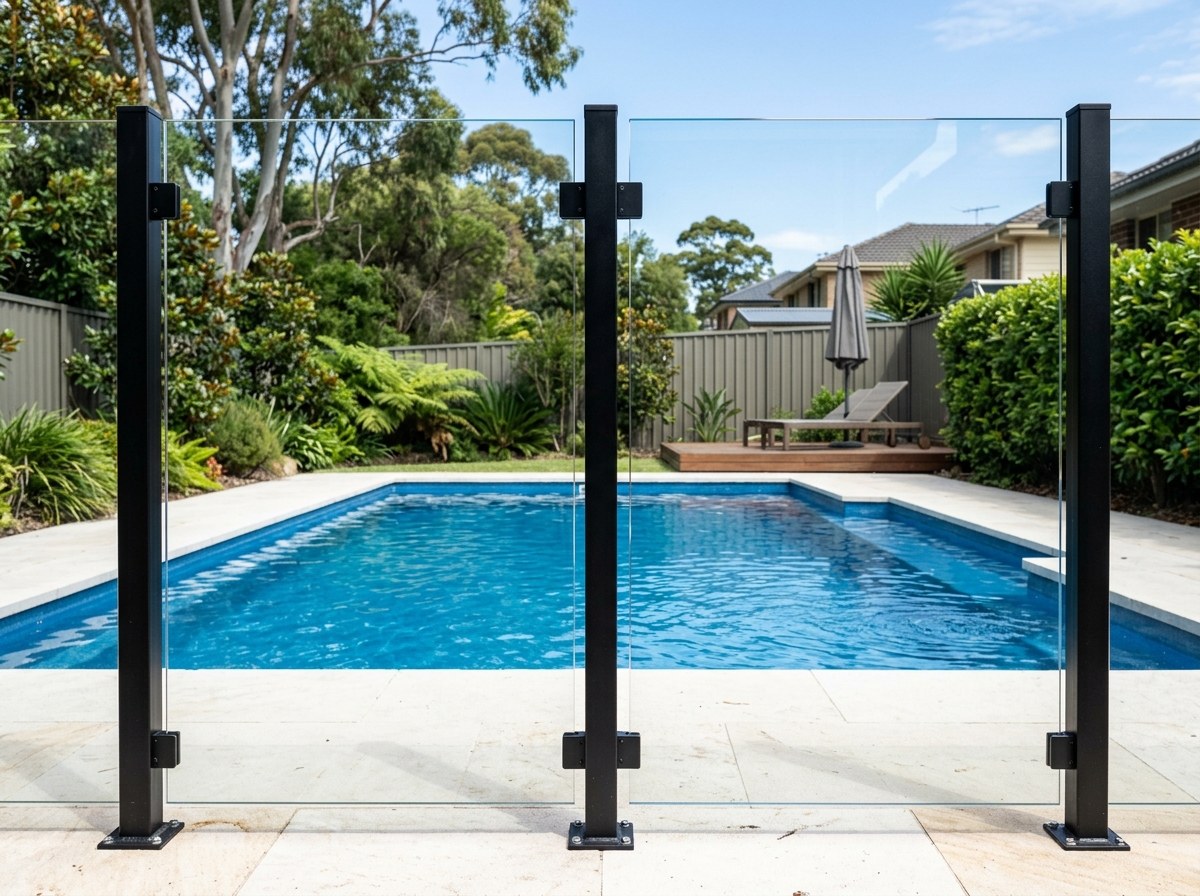
Two Australian Standards sit behind every glass pool fence. AS 1926.1 is the barrier standard: heights, gaps, non-climbable zones, gates and latches. AS 1288, Glass in buildings: Selection and installation, is the glass standard. The Victorian Building Authority’s Practice Note SP-02 ties them together in one line: glass in barriers must comply with AS 1288, and glass used in and around swimming pool areas where human impact could break it must be Grade A safety glazing, with a minimum thickness as prescribed by AS 1288. Standards Australia lists AS 1288:2021 as the current edition, published on 25 June 2021.
The barrier standard has also changed. Standards Australia lists AS 1926.1:2024 as the current edition, published on 23 August 2024, replacing AS 1926.1-2012. Its published summary says the revision aimed to remove ambiguities and keep pace with modern practice, with clearer definitions and diagrams, guidance on plants and objects in non-climbable zones, and updated requirements for gate latches and hinges. The Housing Industry Association adds that the new edition is referenced in NCC 2025, that its changes include glass barriers and testing, and that NCC 2025 overrides one clause so that boundary barriers must still meet the 500 mm clearance requirement. Victoria adopts NCC 2025 from 1 May 2026.
Here is what that means for you in practice. The Commission’s registration page says the barrier standard that applied on the date your pool was constructed is the standard your barrier is judged against. Its own pool safety barriers page, which still names AS 1926.1-2012 for new work, offers different self-assessment checklists depending on whether the pool was installed before 8 April 1991, between 8 April 1991 and 30 April 2010, or from 1 May 2010. The published pages do not say which edition a surveyor will certify a brand new barrier to in late 2026, so do not assume. Ask the building surveyor on your permit before the glass is ordered.
Semi-frameless, frameless or aluminium: choosing a glass pool fence
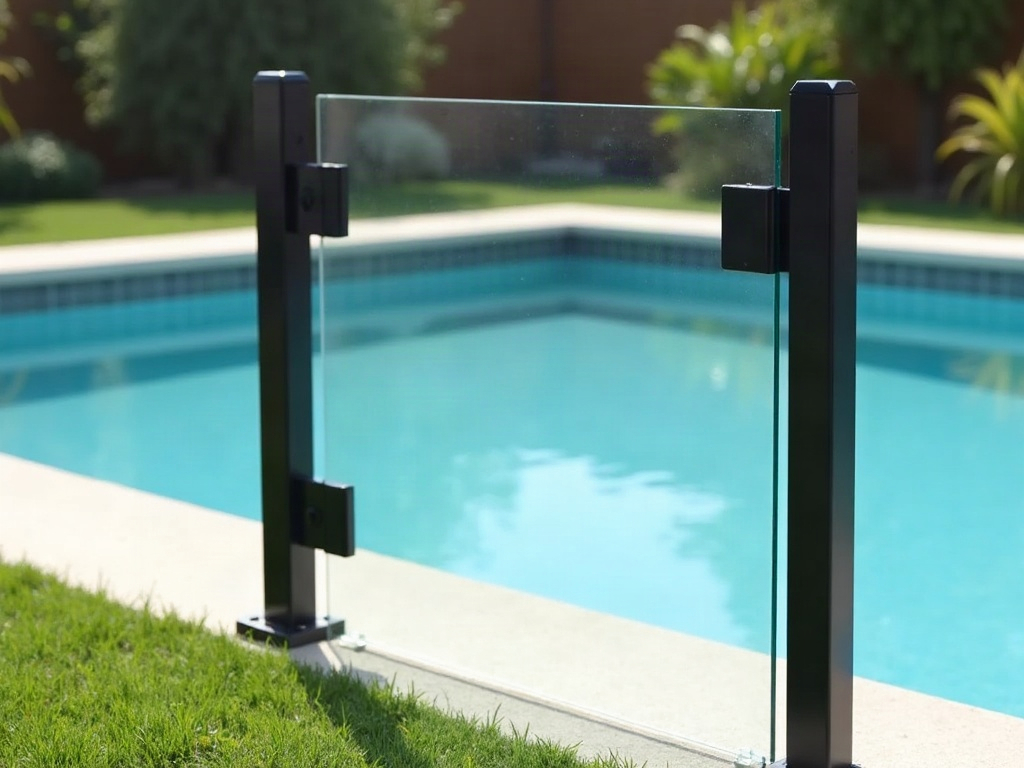
Glass pool fencing comes in two main builds. Yellow Pages’ 2026 cost guide describes semi-frameless fences as glass panels attached to supporting posts, and frameless fences as glass panels secured with ground-mounted brackets or spigots. Semi-frameless is Economy Glass’s standard option. Frameless gives the clearest view but asks more of the ground. The cost guide What’s The Damage? notes that frameless spigots need solid, level concrete or core-drilled footings, and that this groundwork is where frameless quotes vary most.
There is an electrical point that surprises owners. WorkSafe Queensland explained in October 2024 that AS/NZS 3000, the wiring rules, has specific requirements for bonding conductive metal parts within arm’s reach, 1.25 m, of the pool edge, naming metal spigots and poles supporting non-metal fencing. It said installers should consult electricians from the design stage. That is a Queensland regulator quoting a national standard, so ask a licensed Victorian electrician whether bonding applies to your fence. A glazier does not do that work.
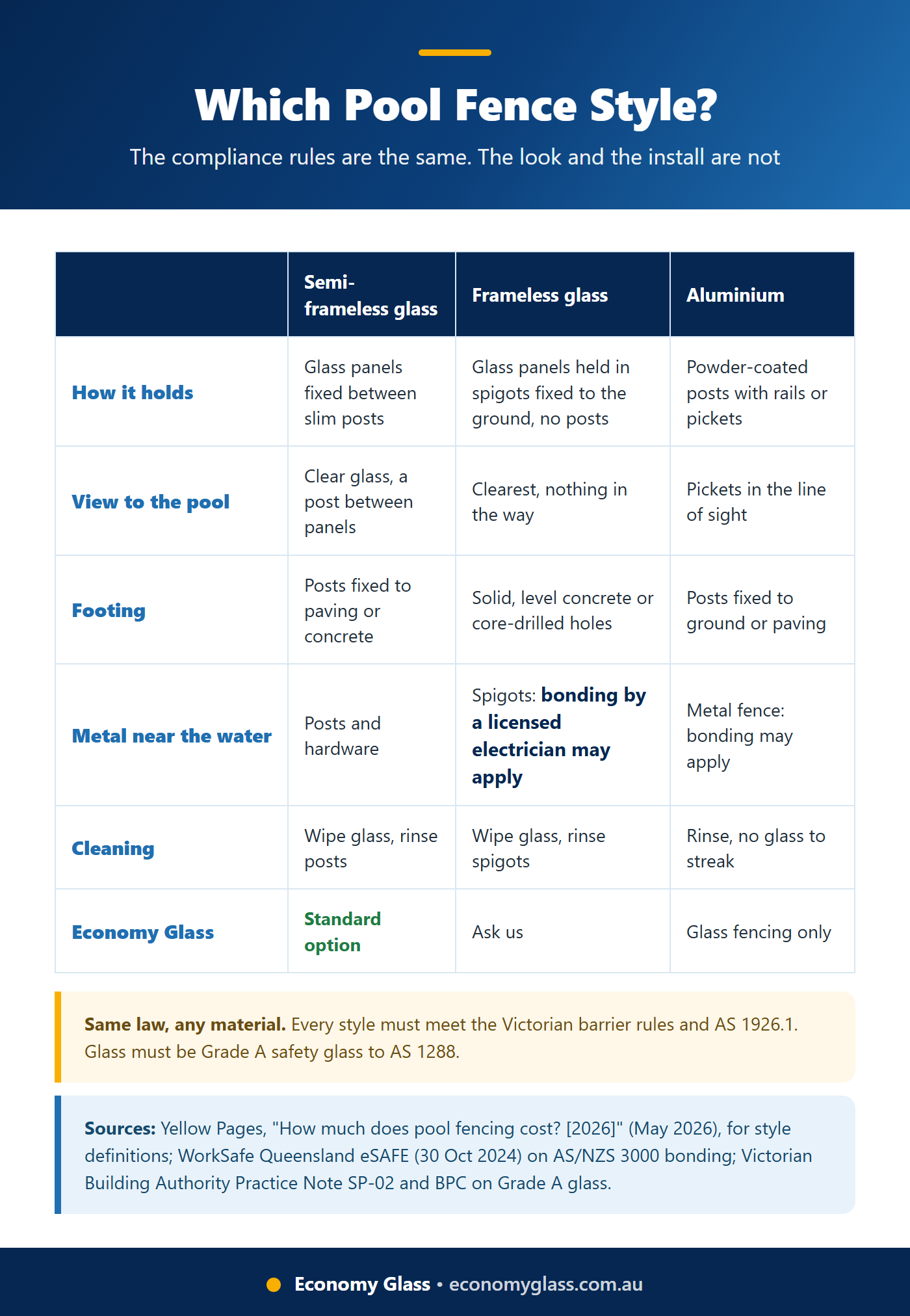
What about glass versus aluminium or tubular fencing? On safety they are equal when both are built and certified to the standard. What’s The Damage? says aluminium meets the same compliance standard as glass and that glass is an aesthetic choice, not a safety upgrade. Yellow Pages says glass gives unobstructed views that can help supervision. Choose glass for the view, not because you think it is safer on paper.
The compliance cycle: registration, inspection and the four-yearly certificate
Victoria’s current system dates from December 2019, when the Government amended the Building Regulations to require owners to register pools and spas and to have barriers certified, according to the Minister for Planning’s 19 October 2021 media release. The registration deadline for existing pools was 1 November 2020. The same release moved the first certificate deadline from 1 November 2021 to 1 June 2022, with later deadlines in June 2023 and June 2024, and confirmed owners must have a registered building surveyor or inspector certify the barrier every four years. On that schedule, the first four-year renewals started falling due from mid-2026, though your council’s letter sets your exact date.
Here is how the cycle works, using the Commission’s page on inspections and compliance, last updated on 30 June 2026.
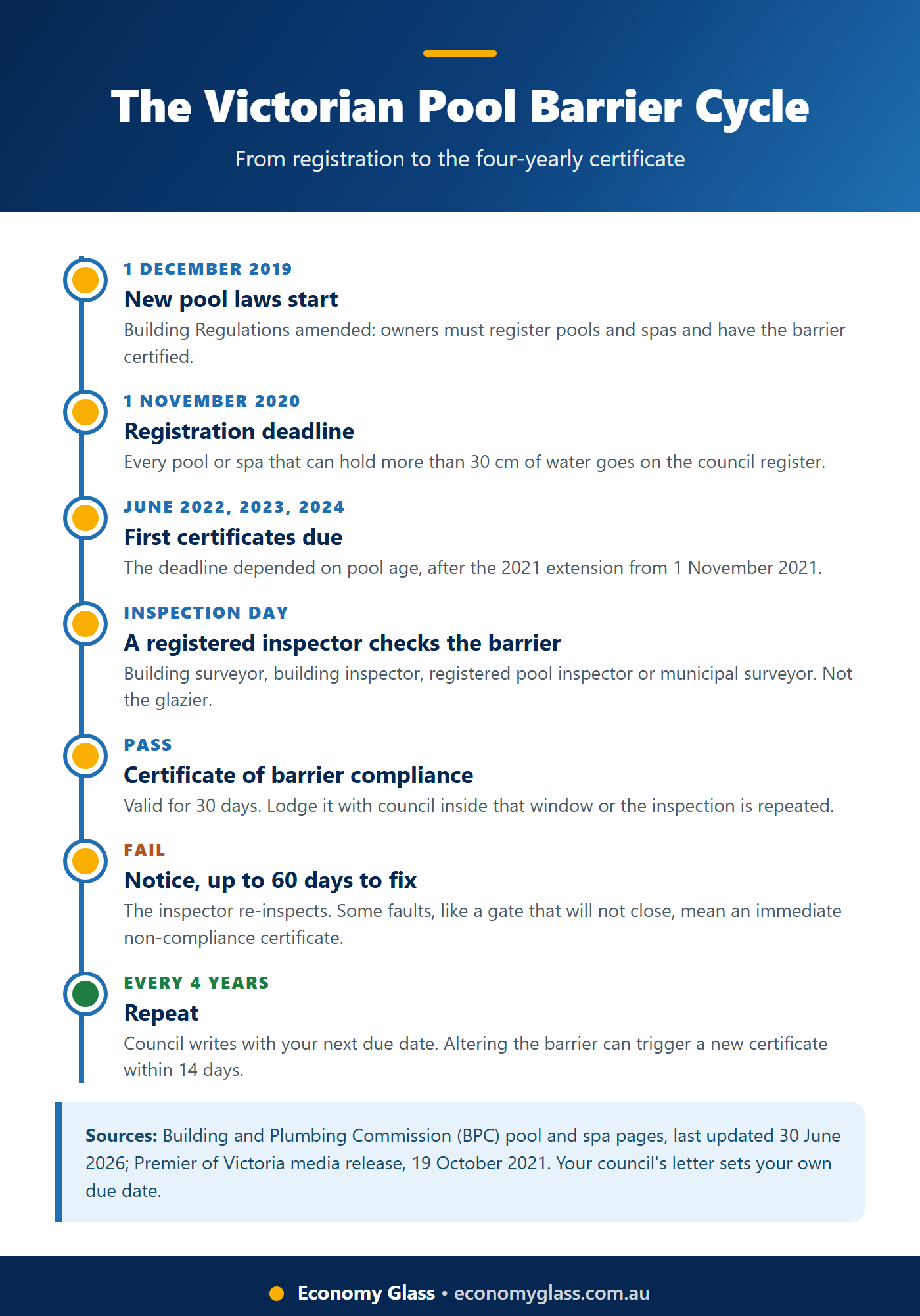
The inspection must be carried out by a registered building surveyor, a registered building inspector, a registered pool inspector or a municipal building surveyor. If the barrier complies, the inspector issues a certificate of barrier compliance. It is valid for only 30 days, and you must lodge it with council in that window, or the inspection has to be repeated. Council then writes confirming the date it was lodged and the date the next certificate is due, four years later. The Commission says there is no set fee for an inspection and recommends quotes from at least two practitioners.
If the barrier does not comply, the inspector can issue a certificate of non-compliance straight away, or a written notice setting out what to fix and a deadline of up to 60 days, with a re-inspection date. Some faults are immediate. The Commission says an inspector must issue a certificate of non-compliance immediately if a closed gate can be opened by someone who cannot reach the opening mechanism, if a gate cannot be completely closed, or if any part of the barrier is below its required height.
Alterations restart part of the clock. The Commission says that if building work that needs a building permit is done on a registered pool’s barrier, the relevant building surveyor inspects it and issues a certificate, and you must lodge it with council within 14 days. Whether a repair needs a permit is a question for your surveyor or council.
Royal Life Saving points out how unusual this is. In a September 2024 statement its research manager noted that only Victoria and Western Australia currently require regular inspections state-wide.
What fails a glass pool fence inspection
Many faults are not about the glass at all. They are about the gate, the zone around the fence and things that have moved since the last inspection. The Commission’s immediate-fail list is the gate that opens for a small child, the gate that will not shut, and the barrier that is too low.
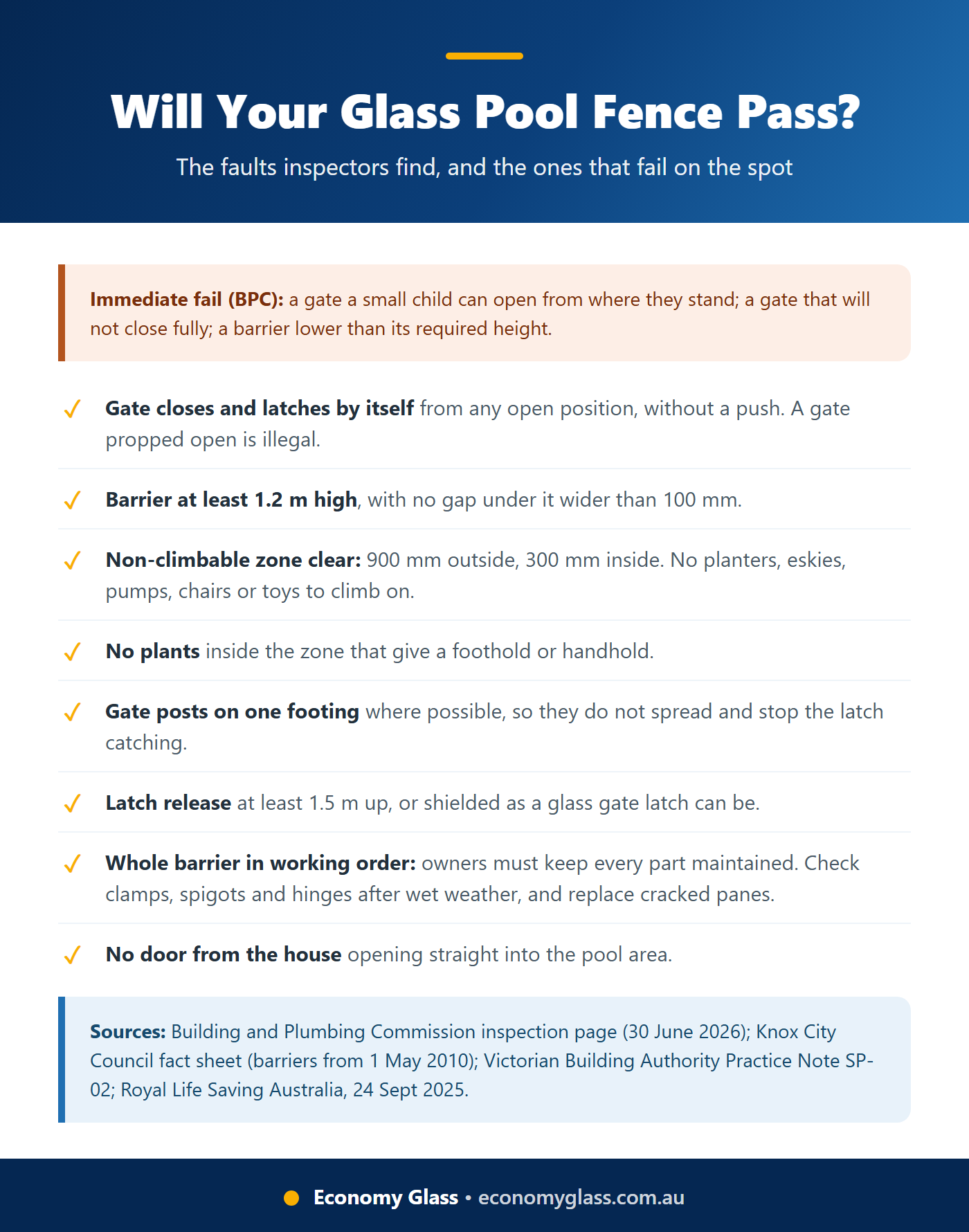
Climbable objects come first. Knox City Council says items like pot plants, eskies, pool pumps and chairs must be moved away from the barrier. Practice Note SP-02 says there must be no plants in the non-climbable zones that could act as a foothold or handhold, and that maintaining adjacent vegetation is the owner’s responsibility.
Footings are next. SP-02 notes that a common problem is posts supporting the gate spreading apart over time when they sit on separate footings, so the gate no longer latches, and recommends pouring the footings as one. If your gate latches fine in summer and sticks after a wet winter, that may be the cause. Royal Life Saving’s Keep Watch advice in September 2025 says to check that wet weather has not loosened fence posts, that gates close properly, and that toys are packed away.
Buying or selling a house with a glass pool fence
Pool duties travel with the land. The Commission’s registration page says it is the owner of the land where a pool is located who must register it and arrange the inspection, so a buyer who settles becomes the person responsible. The same page tells anyone who has recently bought a property with a pool to contact the council to check that the pool has been registered. Council’s registration letter states the construction date, the applicable barrier standard and the next due date.
Whether a seller must hand over a current certificate with the contract of sale is a legal question we cannot answer. Published commentary we found disagrees, and the Commission’s pages do not address it. Ask your conveyancer to check the current section 32 requirements and consider a contract condition covering registration and certification. If you are selling, check the council register and your last certificate date before listing.
How toughened glass breaks, and what a heatwave does to a pool fence
Pool fence glass is toughened: heat treated so it is stronger than ordinary glass of the same thickness and, if it does break, fails into small blunt pieces. Our guide to toughened vs laminated glass compares it with laminated, and our explainer on the toughening process shows how it is made. The thickness is set under AS 1288 panel by panel, so a glazier specifies it for each fence.
Toughened glass is not unbreakable. Civic Shower Screens and Wardrobes, an Australian manufacturer, explains in its technical sheet that toughened glass is impact resistant in the centre but not on its edges. It lists the common causes of toughened glass breaking without an obvious reason: nickel sulphide inclusions inside the glass, glass binding in its frame, thermal stress, inadequate thickness for wind load, and a direct hit to the edge. It describes nickel sulphide inclusions as rare, roughly one in every 8 to 13 tonnes of raw glass depending on the maker, and says heat soak testing reduces that risk without eliminating it.
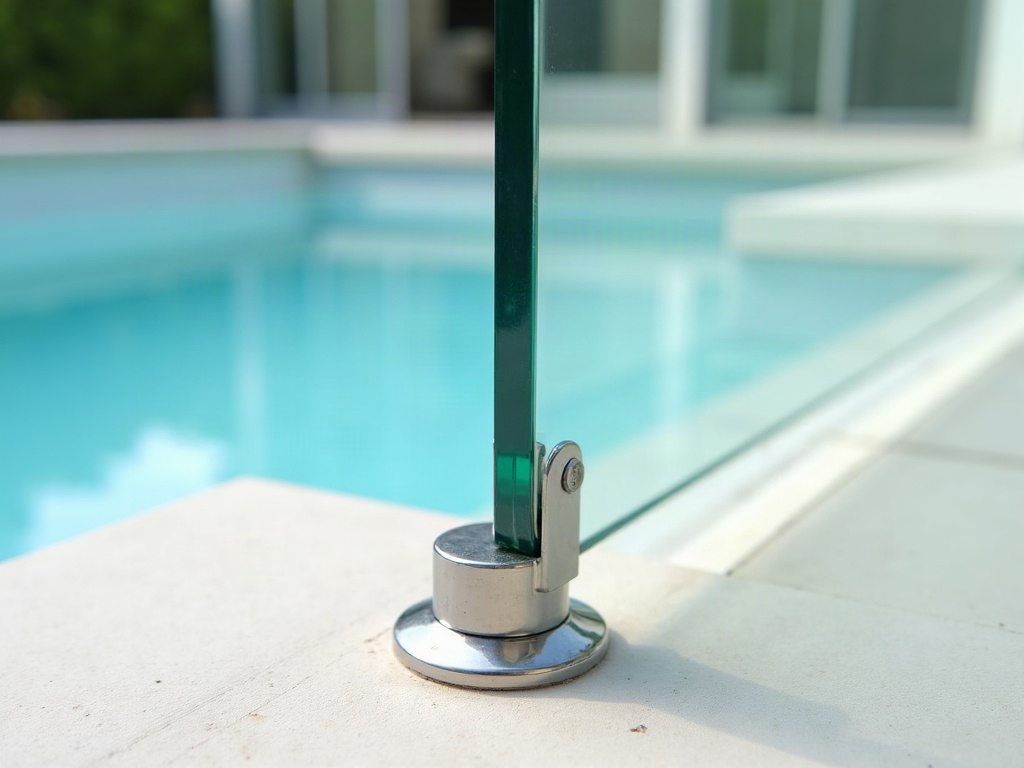
Heat matters on a Melbourne summer day. The same technical sheet explains that when the centre of a pane becomes hotter than its edge, the expanding centre creates tensile stress around the edge, and if that exceeds the edge strength the glass can break. Our post on thermal breakage makes the same point: uneven heating is the cause. For a pool fence, the sheet’s list points to a fitting with no room for the glass to expand, or a panel with a damaged edge. If a pane cracks on a hot day without being hit, tell your glazier when and where. Keep heavy objects and pool equipment off the glass and its edges.
Replacing a cracked glass pool fence panel
A cracked pane is a safety and a compliance problem at the same moment. The Commission says it is the owner’s responsibility to maintain the safety barrier’s effective operation at all times. A cracked or shattered panel may mean the pool is no longer properly fenced, so the first step is to keep children and pets away from the pool and the glass and arrange a safe temporary barrier until the panel is replaced. Do not pull loose pieces out of the fitting.
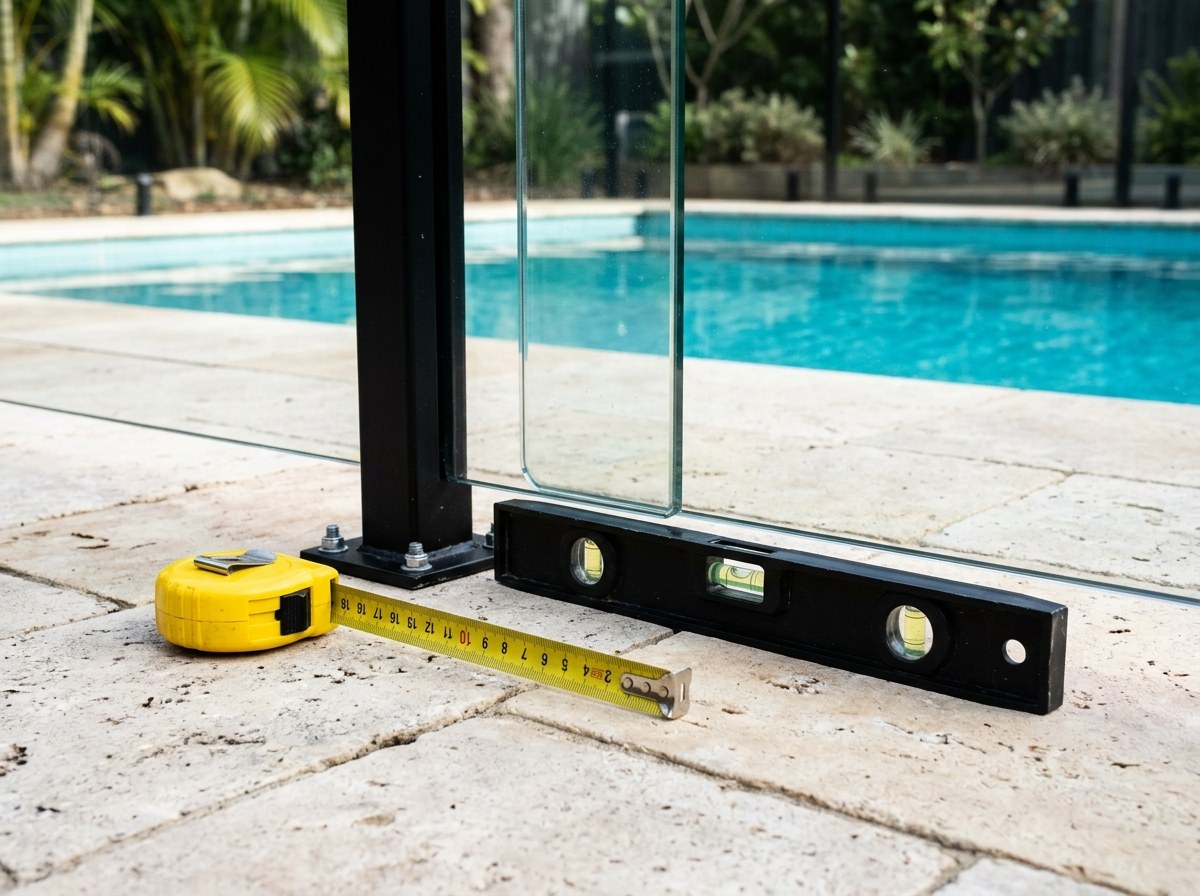
Replacement glass cannot be cut or drilled on site. Toughened glass is made to size, so a glazier measures the opening, has the new panel made with its edges finished, and fits it. That is why a clean, accurate measure matters more than speed. Economy Glass replaces broken and cracked panels, and our glass repairs service handles urgent breakages in business hours, Monday to Friday 8am to 4pm. You can also read how safety glass rules apply across the home and how to tell whether glass is toughened.
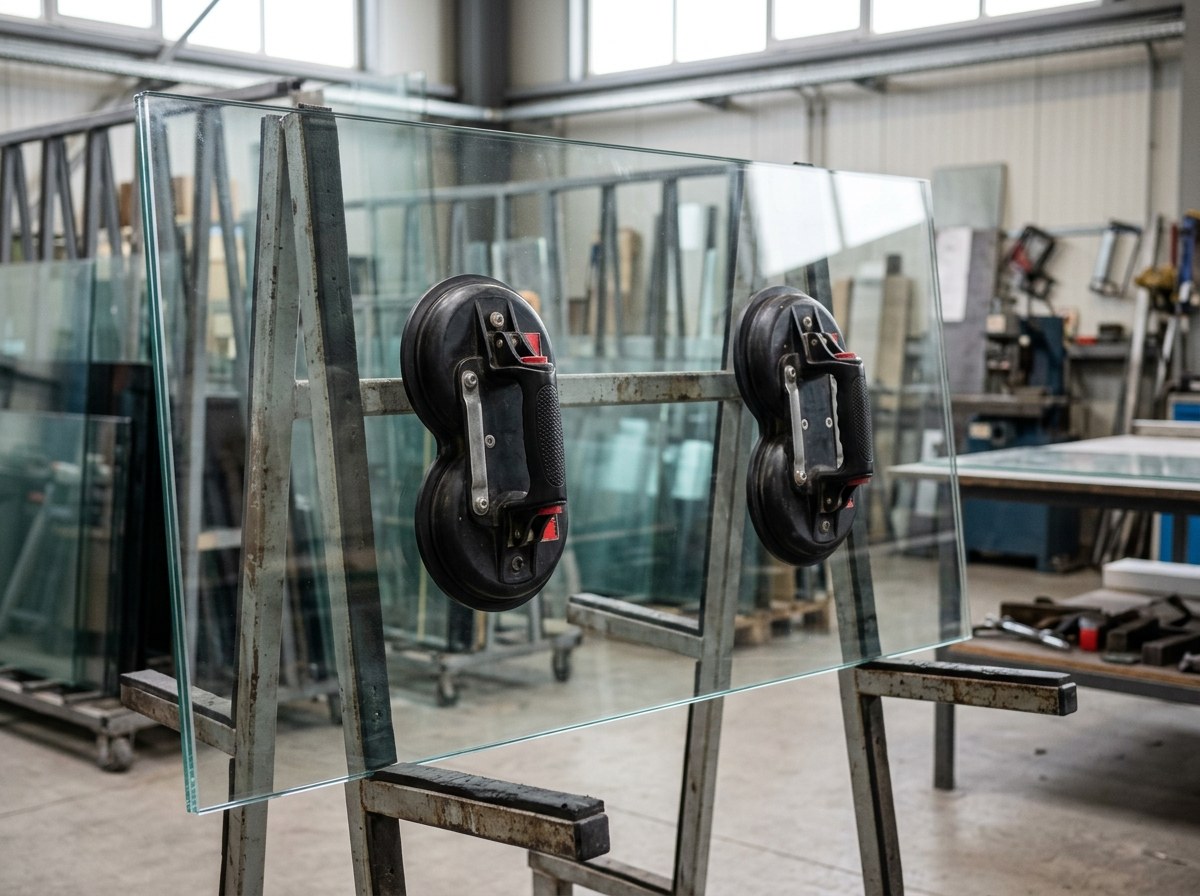
Whether the replacement needs a surveyor’s sign-off depends on what was done to the barrier. The Commission’s rule for permit-triggering work is a certificate lodged within 14 days. If you are unsure, ask your council’s building surveyor before the glazier arrives. A like-for-like pane in an existing fitting is a different job from altering the layout.
Cleaning glass pool fencing: hard water, salt air and hardware
Glass is easy to keep clear if you do it regularly. A Western Australian installer, Teamwork Fencing, recommends a quick hose down, warm water with dishwashing detergent applied with a soft broom or sponge, a cold rinse and a squeegee, and warns against scrapers and abrasive pads that scratch the glass. For marks that will not wipe off, it says hard water deposits need a heavier approach or a professional, and it advises not to scrub with anything abrasive. Our guide to mineral staining explains why hard water leaves permanent marks if it is left to dry again and again.
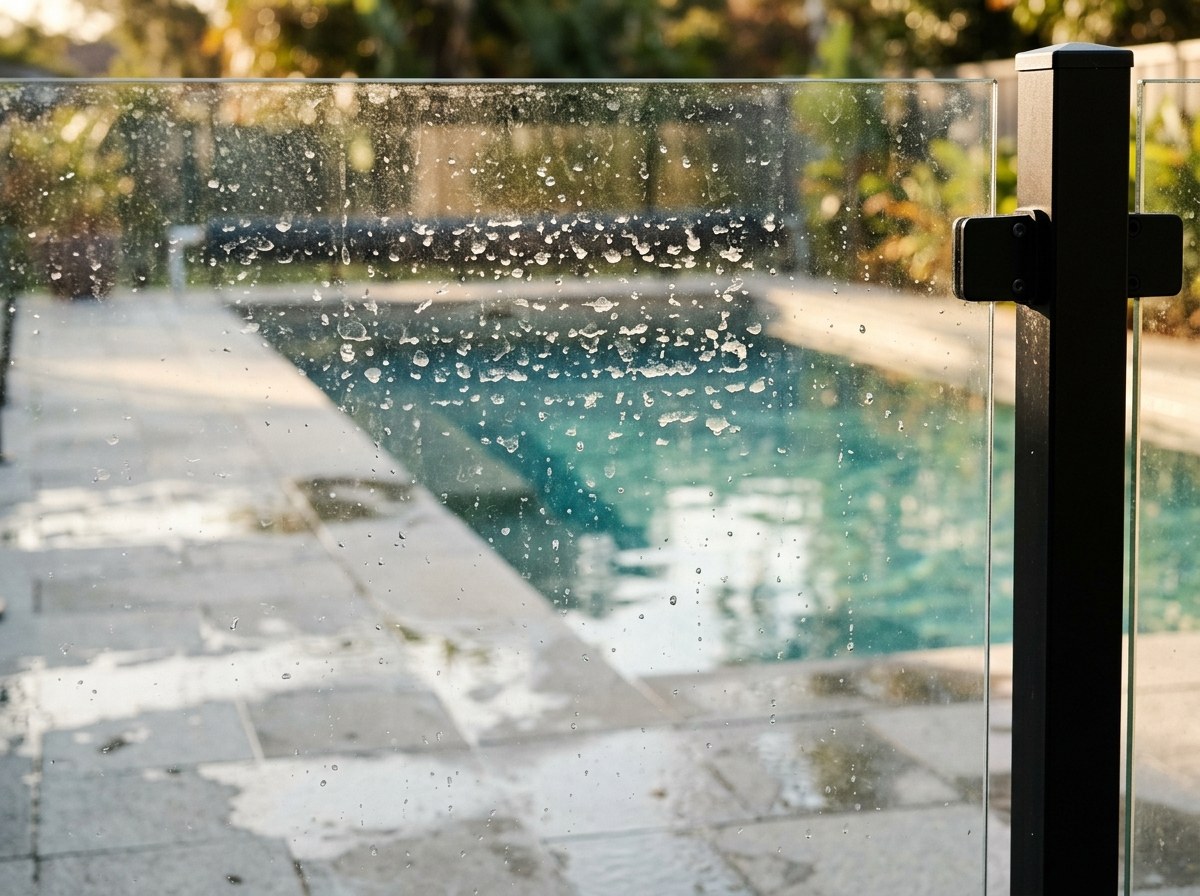
Salt air is the other enemy, mostly of the hardware. Teamwork Fencing’s advice is to clean the glass at least monthly within 10 km of the coast to remove salt build-up, which is a Perth installer’s rule of thumb that applies equally to Williamstown or Point Cook. What’s The Damage? says coastal pools should specify marine-grade stainless hardware to prevent tea-staining, the brown surface rust that shows on stainless steel in salty air. Rinse posts, spigots and hinges with fresh water as part of your regular clean.
Who is responsible: owner, installer and inspector
The roles are separate by law. The owner registers the pool, maintains the barrier, books the inspection and lodges the certificate. The installer supplies and fits the barrier. The inspector certifies it. The Commission says tenants do not register: the owner must. Economy Glass supplies and installs glass pool fencing and replaces broken panes. We do not inspect or certify barriers, and we will say so at the quote.
What drives the cost of a glass pool fence
Price follows the length of the run, the corners, the style, the footings, the gate, the glass specification, site access and whether the block is coastal. We do not publish prices in a guide like this because every job is measured. Our companion piece explains the cost drivers and shows ranges from third-party cost guides, with sources and dates. Read what drives the cost of a glass pool fence in Melbourne before you request quotes.
Glass balustrades and pool-side decks
If your pool sits beside a deck or balcony, the fence may not be your only glass. The Victorian Building Authority’s practice note counts balustrades on a balcony as part of a pool barrier where they form part of the intended barrier. We supply and install glass balustrades for stairs, decks and balconies too. Tell your surveyor and glazier early if a balustrade is doing double duty.
Talk to a glazier
Checking the gate, clearing the zone, cleaning the glass and wiping the hardware are all safe to do yourself. Replacing a panel, adjusting hinges on glass, installing or altering the barrier, and anything involving cracked glass belongs with a glazier, and the electrical bonding belongs with a licensed electrician.
That is where Economy Glass comes in. Economy Glass supplies and installs glass pool fencing across Melbourne’s west and beyond from our Hoppers Crossing workshop, with 45 years in the glass trade and glass cut and finished to Australian Standards. Semi-frameless is our standard option. Call (03) 9360 9900, Monday to Friday 8am to 4pm, or request a quote online. Our Hoppers Crossing service area page shows where we work.
Frequently asked questions
What are the rules for fencing around a pool in Victoria?
What are the Australian standard requirements for glass pool fencing?
How often do pools need to be inspected in Victoria?
What happens if your pool fence is not compliant?
Does a glass pool fence need to be earthed?
How do you clean a glass pool fence?
Is aluminium pool fencing cheaper than glass, and is glass safer?
Does Economy Glass inspect or certify pool fences?
Want to see how the price is built before you ask for quotes? Read what drives the cost of a glass pool fence in Melbourne, or see our guide to safety glass, then request a quote from Economy Glass.