



Three sets of rules decide what glass goes where in a Melbourne home in 2026. AS 1288, the Australian Standard for glass in buildings, says where safety glass is mandatory and what counts as safety glass. The National Construction Code, which Victoria updates to the 2025 edition from 1 May 2026, makes that standard law and sets the energy performance a new home has to reach. And the 7-star NatHERS rating Victoria has required for new homes since May 2024 makes windows part of the energy equation. None of that changes an existing house in Hoppers Crossing, Werribee or Point Cook overnight, but it shapes every pane a glazier fits from here on.
Most people meet these rules in one of two ways. A window or door breaks and the replacement glass has to comply, or a bathroom gets renovated and the old shower screen turns out to be ordinary glass that no glazier will put back. This guide walks through the rules in plain English, what they mean for the glass already in your home, and how to check it yourself in an afternoon.
The rules that decide what glass goes where in 2026
Glass in a home answers two questions: will it hurt someone if it breaks, and how much heat does it let in and out. The first belongs to AS 1288. The second belongs to the National Construction Code and the energy rating schemes under it. A glazier in Melbourne’s west answers both every time a pane is measured up, because getting either one wrong is a job done twice.
The two questions rarely conflict, but they do meet. A sidelight beside a front door in Tarneit needs safety glass because someone can walk into it. The same sidelight in a new build also has to help the whole house reach its 7-star rating. The result is a pane that has to be both the right type of glass and the right performing glass, which is why “just replace it with the same” is not always the right instruction.
Existing homes are not forced to upgrade. The standards apply when glass is installed, so an older Williamstown weatherboard with original windows is not breaking any rule by keeping them. Replace a pane, though, and the new glass has to meet the rules that apply today.
AS 1288 in plain English: where safety glass is mandatory
AS 1288, titled Glass in Buildings: Selection and Installation, is the Australian Standard that governs how glass is chosen and installed in buildings. As Viridian Glass set out in its practical breakdown of the standard for glaziers in May 2026, it covers window and door glazing, overhead glazing, balustrades, shower screens, partitions and frameless assemblies, and compliance with it is required under the National Construction Code. It is not a guideline; it is the rulebook every licensed glazier works to.
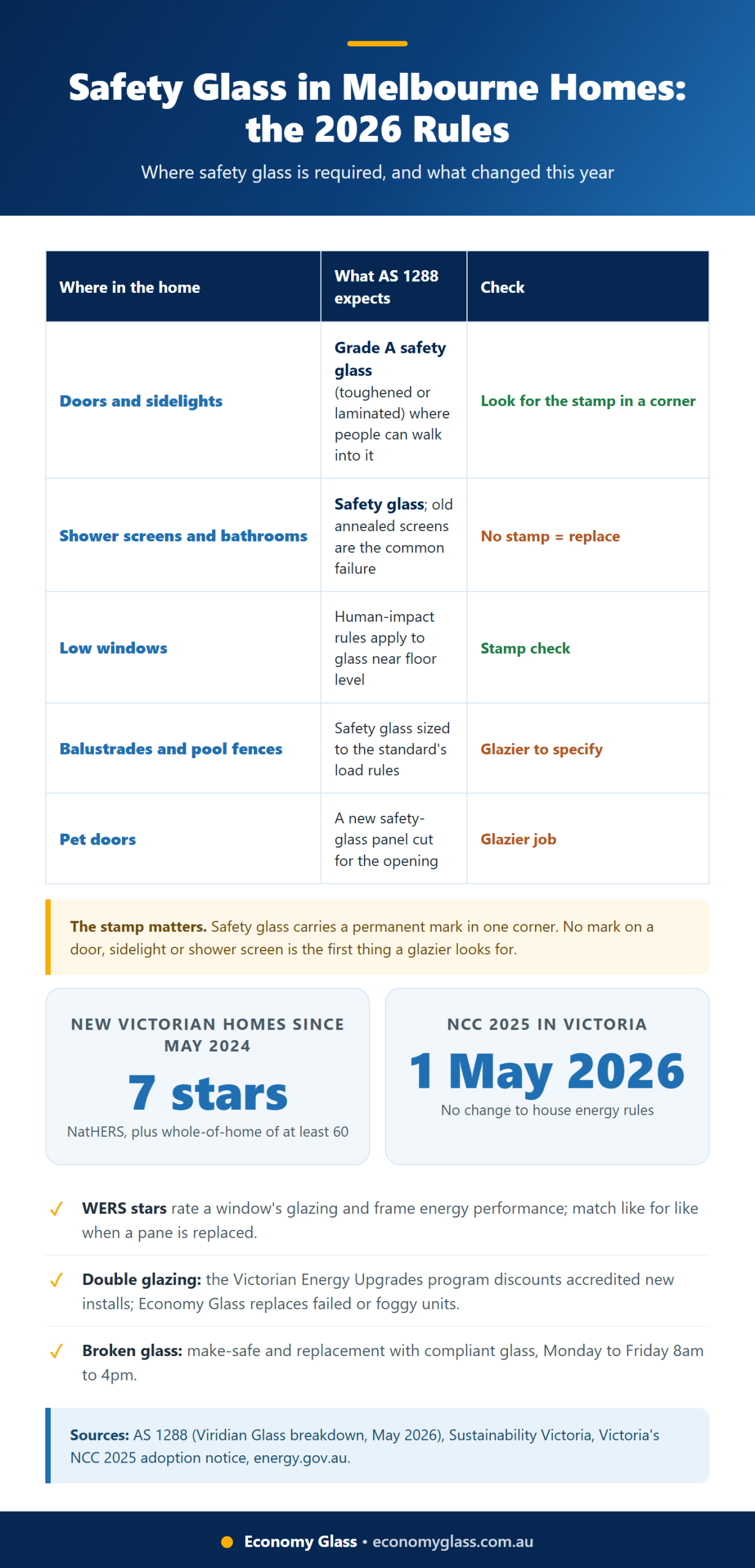
The part that matters most to a homeowner is the section Viridian’s breakdown identifies as Section 5, the human impact rules. Those rules require Grade A safety glass anywhere a person can walk into glass. In a house that means doors, the sidelights beside doors, bathrooms and shower screens, and glazing low enough that someone could stumble or fall into it. Balustrades on stairs and decks, and glass pool fencing, sit in the same family because they exist to stop a person going through them.
Viridian’s breakdown also explains how the standard resolves a conflict. Glass has to be specified for wind load as well as human impact, and where the two rules give different answers, the thicker or stronger result applies. A glazier does not get to pick the cheaper of the two.
The most common non-compliance Viridian flags is a simple one: annealed glass, the ordinary float glass most people picture when they think of a window, used where toughened or laminated glass is required. It turns up in older homes where a door pane was swapped by a handyman, in bathrooms renovated before anyone checked, and in low windows children now run past.
Checking your own glass is easier than it sounds. Safety glass carries a permanent mark, usually etched or printed in one corner of the pane, identifying it as safety glass made to the standard. Ordinary annealed glass has no mark. Look in the corners of a door pane, a shower screen or a low window; if there is no stamp, treat it as annealed until a glazier confirms otherwise.
Toughened or laminated: the two kinds of safety glass
Grade A safety glass comes in two forms, and they behave very differently when they fail. Toughened glass, which Americans call tempered glass, is heat-treated during manufacture so that when it does break it shatters into small blunt pieces rather than long shards. Laminated glass is two panes bonded together with an interlayer, so it cracks under impact but holds together in one sheet instead of falling out of the frame. Both count as Grade A safety glass when they are made and marked to AS 1288.
Which one belongs where comes down to what you need the glass to do after it breaks. Toughened glass suits shower screens, pool fencing, balustrades and glass doors because it clears the opening safely and completely. Laminated glass suits a ground-floor window facing the street, an overhead pane, or anywhere you want the glass to stay put after impact and keep the weather out until it is replaced.
Our companion guide, toughened vs laminated glass, compares the two in more detail, including which to ask for in a door, a window, a balustrade or a table top. The short version: if a pane sits where AS 1288 says a person can walk into it, it has to be one of the two, and the stamp in the corner tells you which.
The shower screen case: why old annealed screens get replaced
Shower screens are where the AS 1288 human impact rules land hardest in an ordinary house, because a bathroom combines wet floors, bare skin and a sheet of glass at exactly the height a person falls against. Viridian’s breakdown names bathrooms and shower screens among the places Grade A safety glass is required, and every screen fitted by a licensed glazier today is toughened glass with the stamp to prove it.
Older homes across Werribee and Hoppers Crossing still have screens that predate that thinking: framed aluminium units with annealed panels, or a glazed panel somebody swapped in decades ago. They are not illegal to keep, but no glazier will reinstall one, and once a panel cracks the replacement is compliant toughened glass or a new screen.
Renovations are the other trigger. Pull a bathroom apart and the old screen rarely fits the new layout, so the choice becomes which new screen to fit. That decision is about glass and hardware rather than rules, since every new screen uses safety glass, and we cover it in frameless vs semi-frameless shower screens. Both styles are measured and made at our Hoppers Crossing workshop, and the full range is on our shower screens page.
The energy side: 7-star homes, WERS stars and NCC 2025
Safety is only half the story. Since May 2024, according to Sustainability Victoria, new Victorian homes have had to achieve a 7-star NatHERS rating and a whole-of-home rating of at least 60. The NatHERS rating covers the building envelope, which Sustainability Victoria lists as the roof, walls, floor and windows. Windows are the part of that list that moves heat fastest in both directions, which is why the glazing choice in a new home matters far more than it used to.
Windows also get their own scorecard. The Window Energy Rating Scheme, or WERS, rates a window’s glazing and frame energy performance in stars, as Sustainability Victoria describes it, so a builder or homeowner can compare one window against another before it goes in. When you hear “window energy rating” in a conversation about a new build in Point Cook, WERS is what is being discussed.
Then there is the code itself. Victoria adopts the National Construction Code 2025 from 1 May 2026, as MS Consultants reported when the Minister confirmed the date on 30 March 2026. For houses the important detail is what does not change: MS Consultants notes there are no changes to the residential energy-efficiency requirements compared with NCC 2022, so the 7-star benchmark, the whole-of-home requirement and the glazing and insulation settings all stay the same.
For a replacement pane in an existing home, that means like-for-like performance. When a glazier replaces a broken pane in a house built to the 7-star rules, the new glass should match what the window was rated with, so the house keeps performing as designed. In an older home the rules do not force an upgrade, but the moment the frame is open is the easiest time to ask what a better pane would do for comfort.
Double glazing, honestly
Interest in double glazing Melbourne-wide has grown with the 7-star rules, so it deserves a straight answer. A double-glazed unit is two panes sealed around a spacer, and the gap between them is what slows heat moving through the window. The seal is the part that fails: once it gives out, moisture gets in and you get the fogging between the panes that no amount of cleaning will fix.
The Victorian Government’s Victorian Energy Upgrades program, as described by energy.gov.au, offers discounts on a range of energy-saving products for households, and replacing single glazing with compliant double glazing installed by an accredited provider is on the list of eligible upgrades. If you want to convert a single-glazed home, that program and its accredited providers are the path to look into.
Economy Glass does not install new double glazing under that program, and we would rather say so plainly than have you find out at quote time. What we do is replace failed or foggy double-glazed units: we measure the existing unit, have a new sealed unit made to match, and fit it back into your existing frame. If one of your double-glazed windows has fogged, cracked or lost its seal, that is squarely our work.
Pets, kids and glass
Families in Melbourne’s west put glass under more stress than the standards anticipate. Children run at sliding doors. Dogs lean on sidelights and scratch at the panel beside the back door. The human impact rules in AS 1288 exist for exactly these moments, and they are the reason a glazier will not fit anything but safety glass in a door or a low window in a family home.
Pet doors are the special case. A dog or cat door cannot be cut into a toughened panel after it is made, because toughened glass shatters the moment it is cut. Instead, a glazier measures the panel, has a new safety glass panel made with the opening already in it, and fits the pet door into that panel in place of the original. The result is a compliant pane with a proper pet door, and it is not a task for a glass cutter on the kitchen floor.
When glass breaks: repair, make-safe and compliant replacement
A broken pane changes the question from “does this comply” to “what happens now”, and the answer runs in three steps. First, keep people and pets away from the glass and do not pull loose pieces out of the frame; broken annealed glass comes away in long edges and laminated glass still has sharp edges along every crack. Second, make the opening safe. Third, replace the glass with a pane that complies with AS 1288 for where it sits, the step that matters long term.
Economy Glass handles glass repairs and window glass replacement across Melbourne’s west within business hours, Monday to Friday 8am to 4pm. Urgent breakages are prioritised in those hours, and account customers get priority make-safe so a shopfront or office is not left open. The broken pane is measured, and a compliant safety glass replacement is cut and finished at our Hoppers Crossing workshop and fitted.
The one thing not to do is put the wrong glass back for the sake of speed. A door pane replaced with annealed glass is the exact non-compliance Viridian describes as the most common in the trade. Ask what glass is going in, ask to see the stamp, and if the answer is vague, ask a different glazier.
How to check your own home: a six-point walk-through
You do not need a glazier to find out where your home stands. Take a torch and a notepad and walk the house with these six checks, all of which are looking and measuring only.
- Doors and sidelights. Check every glazed door, including the sliding door to the yard, and the narrow panels beside the front door. Look for the safety mark in a corner of each pane. No stamp means treat it as annealed.
- Shower screens. Find the stamp on every panel, including the fixed panel and the door. Check the hinges, pivot and towel rail for movement and the seal along the base for gaps. A loose hinge on a toughened panel is a glazier repair, not a squirt of sealant.
- Low windows. Walk the hallways, stairwell and any landing and note windows glazed close to the floor. These are the panes most likely to be old annealed glass in a walk-into location.
- Balustrades and pool fencing. Look for the stamp on each glass panel and check that the clamps, spigots or channels holding them are tight. Do not attempt to re-seat a panel yourself.
- Double-glazed units. Look for fogging, misting or a tide mark between the panes on a cold morning. A fogged unit has lost its seal and is a candidate for replacement.
- Pet doors and modified panels. If a pet door, cat flap or vent has been fitted into a glass panel at some point, check that the panel has a safety stamp. A pet door cut into an annealed panel is a replacement job.
Write down what you find. Nothing on the list obliges you to act today, but when a pane breaks or a bathroom is renovated, you will know which glass the replacement has to be before anyone quotes you.
Talk to a glazier
Checking the stamp, cleaning the glass, measuring an opening and tightening a loose handle are all safe to do yourself. Cutting glass, fitting a pet door into a panel, replacing a pane, anything involving broken glass, and any structural glazing such as a balustrade or a frameless screen belong with a glazier, because the glass has to be the right type, cut to size and finished to the standard before it goes in.
That is where Economy Glass comes in. Economy Glass supplies and installs safety glass across Melbourne’s west and beyond from our Hoppers Crossing workshop, with 45 years in the glass trade and glass cut and finished to Australian Standards. Call (03) 9360 9900, Monday to Friday 8am to 4pm, or request a quote online.
Safety Glass in Melbourne Homes: The 2026 Rules: the quick version
Save or print this checklist before you call.
Frequently asked questions
What is safety glass?
How do I tell if the glass in my doors and shower is safety glass?
Does NCC 2025 change the glass I need in my home?
Is my old annealed shower screen illegal?
Does Economy Glass install double glazing?
Want to go deeper on the glass itself? Read our companion guides on toughened vs laminated glass and frameless vs semi-frameless shower screens, or request a quote from Economy Glass.